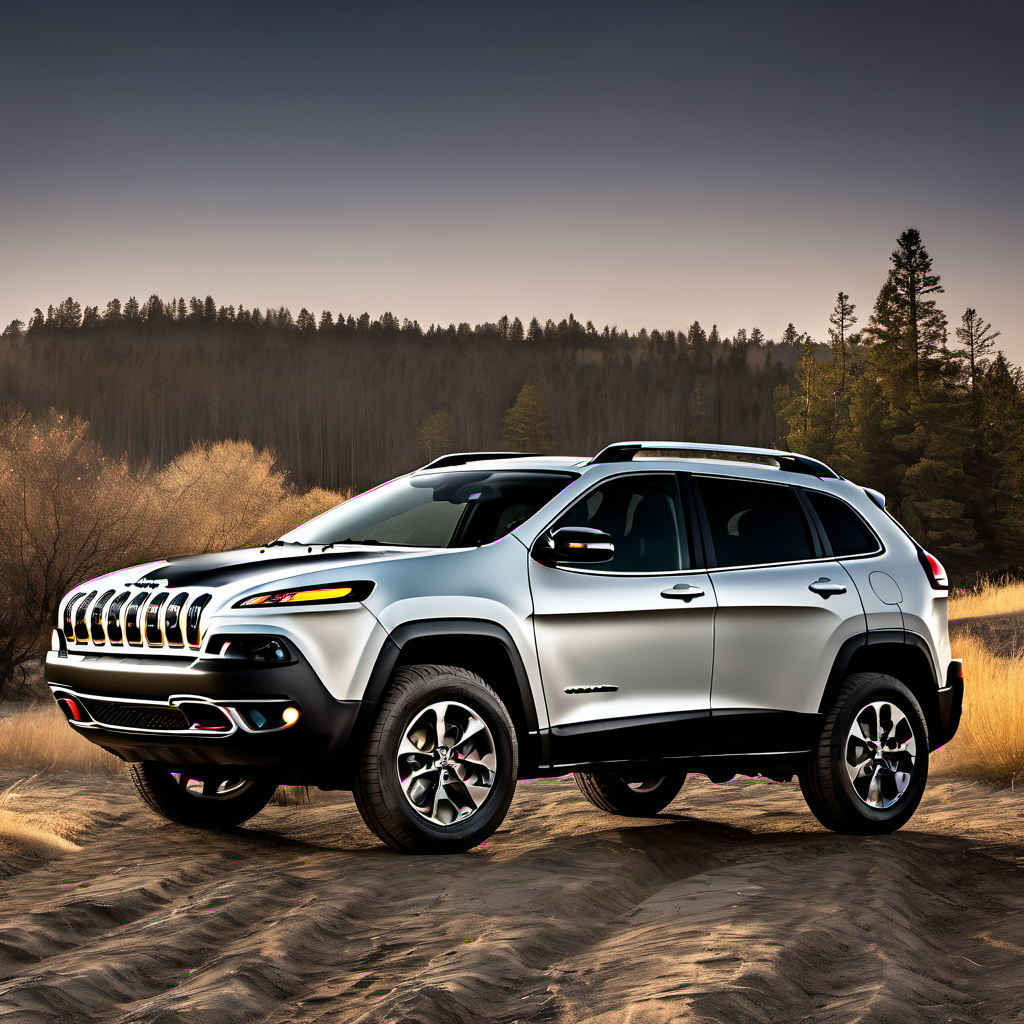
2015 Jeep Cherokee SUV

2015 Jeep

CherokeeSUV

3.2L V6 Pentastar · SUV

The 2015 Jeep Cherokee (KL generation) was a significant departure from the previous Liberty — it moved to a unibody platform shared with the Dodge Dart and Jeep Compass/Patriot family, trading body-on-frame ruggedness for a more car-like ride and better fuel economy. It came in front-wheel drive and available 4WD configurations, targeting buyers who wanted Jeep capability without the truck-like ride of a Wrangler. The base engine is a 2.4L Tigershark inline-four, but the real-world workhorse most buyers chose is the 3.2L Pentastar V6. Both engines can be paired with Jeep's 9-speed ZF-sourced automatic transmission — and that transmission is the Cherokee's defining ownership experience. Early examples had serious shift quality and software issues; later software updates helped but didn't fully cure all complaints. For Lake Geneva-area buyers, the available Active Drive 4WD system with low-range (Trailhawk trim) is genuinely useful in Wisconsin winters, but the 9-speed transmission quirks and above-average ownership costs are real considerations before buying, especially used.

Reliability
2/5
Verified data
Specs shown for Cherokee 4WD Active Drive II — the most common configuration. Other trims may vary in engine, drivetrain, or fuel economy. Sign in to see your vehicle's exact specs.
Engine
[object Object]
Drivetrain
4WD
Fuel
Gasoline
MPG
19 city / 27 hwy / 22 combined
Seats
5
Doors
4
Body
SUV
MSRP
$29,095

Overview

AI-curated

The 2015 Jeep Cherokee (KL generation) was a significant departure from the previous Liberty — it moved to a unibody platform shared with the Dodge Dart and Jeep Compass/Patriot family, trading body-on-frame ruggedness for a more car-like ride and better fuel economy. It came in front-wheel drive and available 4WD configurations, targeting buyers who wanted Jeep capability without the truck-like ride of a Wrangler. The base engine is a 2.4L Tigershark inline-four, but the real-world workhorse most buyers chose is the 3.2L Pentastar V6. Both engines can be paired with Jeep's 9-speed ZF-sourced automatic transmission — and that transmission is the Cherokee's defining ownership experience. Early examples had serious shift quality and software issues; later software updates helped but didn't fully cure all complaints. For Lake Geneva-area buyers, the available Active Drive 4WD system with low-range (Trailhawk trim) is genuinely useful in Wisconsin winters, but the 9-speed transmission quirks and above-average ownership costs are real considerations before buying, especially used.

Known for
  • Distinctive love-it-or-hate-it styling with split headlights
  • Troublesome 9-speed ZF automatic transmission — the Cherokee's biggest weak point
  • Capable Active Drive 4WD available on most trims
  • Comfortable, car-like ride quality for a small SUV
  • 3.2L Pentastar V6 is a proven, reasonably durable engine
Best for
  • Commuters who want occasional light off-road or AWD capability
  • Wisconsin/Midwest winters with available 4WD
  • Families needing a small SUV with good interior space
  • Budget-conscious buyers willing to accept some reliability trade-offs
Watch for
  • 9-speed transmission shudder, hesitation, and harsh shifting — check for updated software
  • VVT system oil sludge issues on the 2.4L engine if oil changes were skipped
  • Rust on underbody and brake lines — critical concern given Wisconsin road salt
  • TIPM (electrical module) gremlins causing random electrical faults
  • High repair costs relative to competitors when things go wrong

Common issues by mileage

6 known

9-Speed Automatic Transmission Shudder and Harsh Shifting

high
Typically appears
0–80k mi
Estimated repair
$150 – $4,500

Oil Sludge / VVT System Failure (2.4L Tigershark)

high
Typically appears
50–100k mi
Estimated repair
$800 – $3,500

Oxygen Sensor and Heater Circuit Faults

medium
Typically appears
80–130k mi
Estimated repair
$150 – $450

Underbody and Brake Line Rust (Wisconsin/Salt Belt)

high
Typically appears
50k+ mi
Estimated repair
$400 – $2,500

Maintenance schedule

  1. 1
    Every 5,000 miles or 6 months (do NOT stretch to OLM maximum on the 2.4L) Engine oil change — use correct 0W-20 full synthetic

    The 2.4L Tigershark is extremely sensitive to oil quality and change intervals. Sludge buildup directly causes VVT solenoid failures and camshaft timing codes. Full synthetic at shorter intervals is cheap insurance against a $1,000+ repair.

  2. 2
    Every 40,000–45,000 miles regardless of 'lifetime' fluid claims Transmission fluid service

    The 9-speed ZF is already stressed on this platform. Fresh fluid helps shift quality and protects internal components. Jeep's 'lifetime fill' designation is not appropriate for this application.

  3. 3
    Every fall before winter, and every spring Brake line and underbody inspection

    Wisconsin road salt aggressively attacks the brake lines, frame rails, and suspension components on this generation Cherokee. Catching early rust and treating it costs far less than brake line replacement after failure.

  4. 4
    At purchase if used; confirm current software version Check and update transmission software / TCM calibration

    Multiple TSBs exist for the 9-speed. An out-of-date calibration causes the most complained-about shift behavior. A shop with a Witech scan tool can confirm current software level.

  5. 5
    Every 15,000–20,000 miles Air filter and cabin air filter replacement

    Cabin filter is especially important in Wisconsin for keeping road salt and sand debris out of the HVAC system. Easy DIY swap.

  6. 6
    Every 60,000 miles Spark plugs (3.2L V6)

    Factory spec. Worn plugs on the V6 can trigger misfires and stress the ignition coils. Do all six at once.

  7. 7
    Every 45,000 miles 4WD system service — transfer case and front differential fluid

    The Active Drive units are electronically controlled and benefit from clean fluid. Neglected fluid leads to coupling failure, which is an expensive repair.

  8. 8
    Every fall, especially after age 3–4 years Battery load test

    Sub-zero Wisconsin starts are hard on batteries. The Cherokee's electrical system (TIPM) is sensitive to low voltage — a weak battery can cause a cascade of false fault codes and module communication errors.

Always defer to the manufacturer's service manual for warranty-mandated intervals.

Cost of ownership

Annual maintenance
$700 – $1,800
Fuel
At 22 MPG combined and Wisconsin average gas prices, expect roughly $1,800–$2,400/year for typical 12,000–15,000 mile driving.
Insurance
Moderate — mid-size SUV rates, typically $1,100–$1,600/year for full coverage in the Lake Geneva area depending on driver profile.

The Cherokee's total ownership cost runs higher than class competitors like the Honda CR-V or Toyota RAV4. Routine maintenance is reasonable, but the transmission and VVT system create elevated risk of $500–$4,000 repairs in the 60k–120k mile window. Budget accordingly and keep a maintenance fund. A well-documented service history on a used example dramatically changes the risk profile.
Seasonal care

Lake Geneva, WI
Winter
  • Switch to winter/all-season tires rated for severe snow service (3PMSF symbol) — the Active Drive system helps traction but cannot overcome summer tire limitations on ice
  • Load-test the battery every October; cold cranking amps drop sharply below 20°F and a weak battery causes TIPM and CAN bus fault codes
  • Use a windshield washer fluid rated to at least -20°F — Wisconsin temps regularly exceed standard fluid freezing points
  • Inspect and treat underbody, wheel wells, and brake lines before first snowfall; rinse the undercarriage after every heavy salt event
  • Check antifreeze concentration to -34°F minimum with a refractometer
  • Verify that all 4WD modes engage and transfer case shifts correctly before winter arrives — do not discover a failed coupling in a snowstorm
Summer
  • Check tire pressure monthly — for every 10°F rise in temp, pressure increases ~1 PSI; set to cold spec in the morning
  • Have the A/C system checked if cooling is weak — the Cherokee's condenser sits low and is vulnerable to debris and road damage
  • Inspect the cabin air filter after pollen season; clogged filters reduce A/C efficiency and blower motor life
  • Check coolant level and hose condition — the 2.4L Tigershark runs warm and a deteriorating hose is a tow-truck call in summer heat

Comparable vehicles

If you're shopping for one

Red flags
  • Any P0012, P0015, P0022, or P0025 codes — indicates VVT system damage, possibly from sludge; walk away or negotiate heavily
  • Transmission shudder or hunting during test drive with no record of fluid service or software update
  • Visible rust on brake lines or heavy surface rust on frame rails — replacement is expensive and a safety issue
  • U0100–U0104 network codes present at time of purchase — can indicate TIPM failure or wiring damage
  • No service records and high mileage — the 2.4L Tigershark does not forgive missed oil changes
  • Multiple prior owners in a short period — often a sign the previous owner gave up on recurring transmission or electrical problems
What to inspect
  • Have the transmission software version checked — confirm it has the latest TCM calibration on file
  • Test drive specifically for transmission shudder between 30–45 MPH and abrupt downshifts at low speed
  • Pull service records and verify oil changes at 5,000-mile intervals — VVT damage from sludge won't always show a code yet
  • Inspect the underside for brake line rust, frame rail rust, and suspension corrosion — pay extra attention if it's a Wisconsin/salt-state vehicle
  • Run a full scan for stored and pending codes, especially P001x/P002x camshaft timing codes and U01xx CAN bus codes
  • Check the battery with a load tester, not just a voltage check
AI profile generated 22 days ago · claude-sonnet-4-6 · v2.