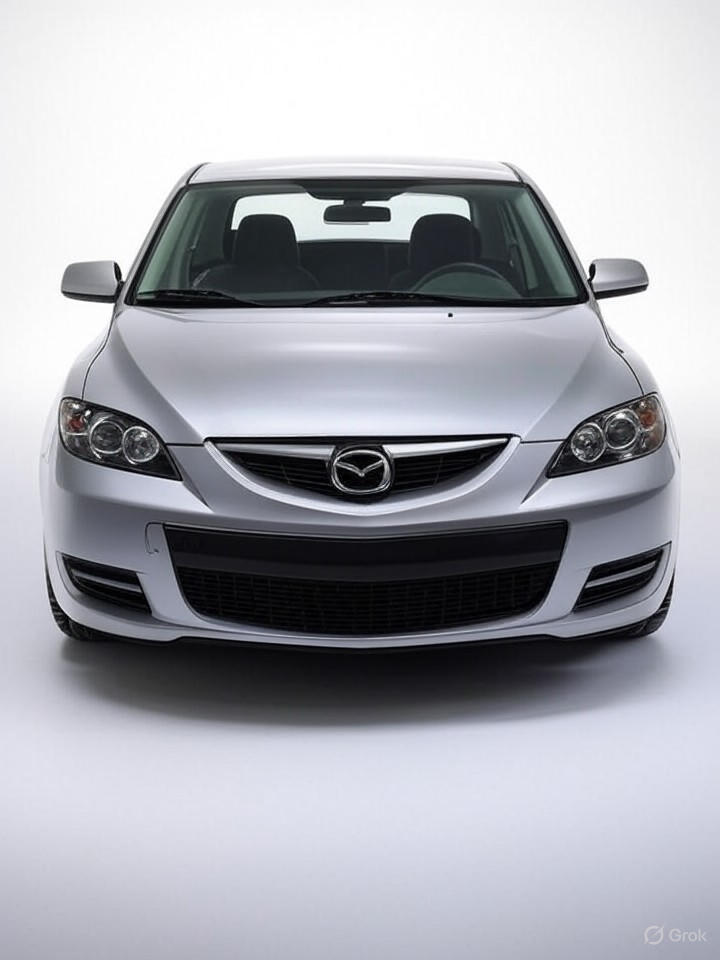
2006 MAZDA MAZDA3 Sedan

2006 MAZDA

MAZDA3Sedan

2.0L I4 · Sedan

The 2006 Mazda3 sedan is the first generation (BK platform) of Mazda's compact sport sedan, built on the Mazda/Ford global C1 architecture shared with the Ford Focus of that era. It earned a loyal following for combining genuine driving enjoyment with Japanese reliability — a rare combination at its price point. The 2.0L and 2.3L four-cylinders are smooth and willing, and the chassis gives the car a planted, responsive feel that most competitors in the segment simply couldn't match. By 2006 Mazda had ironed out most of the early first-gen teething issues, making this a relatively mature and dependable entry-level sport sedan. Fuel economy is solid for its era, parts are widely available, and independent shop labor costs are low thanks to a straightforward engine bay. It's an especially good value when maintained consistently. The biggest weakness on any first-gen Mazda3 at this age is rust — Wisconsin road salt is brutal to the subframes, rear wheel wells, and rocker panels. A solid undercarriage inspection is non-negotiable before buying or keeping one long-term in this region.

Reliability
4/5
Verified data
Engine
2.0L I4
Drivetrain
FWD
Fuel
Gasoline
MPG
24 city / 32 hwy / 27 combined
Seats
5
Doors
4
Body
Sedan
MSRP
$15,850

Overview

AI-curated

The 2006 Mazda3 sedan is the first generation (BK platform) of Mazda's compact sport sedan, built on the Mazda/Ford global C1 architecture shared with the Ford Focus of that era. It earned a loyal following for combining genuine driving enjoyment with Japanese reliability — a rare combination at its price point. The 2.0L and 2.3L four-cylinders are smooth and willing, and the chassis gives the car a planted, responsive feel that most competitors in the segment simply couldn't match. By 2006 Mazda had ironed out most of the early first-gen teething issues, making this a relatively mature and dependable entry-level sport sedan. Fuel economy is solid for its era, parts are widely available, and independent shop labor costs are low thanks to a straightforward engine bay. It's an especially good value when maintained consistently. The biggest weakness on any first-gen Mazda3 at this age is rust — Wisconsin road salt is brutal to the subframes, rear wheel wells, and rocker panels. A solid undercarriage inspection is non-negotiable before buying or keeping one long-term in this region.

Known for
  • Sharp, engaging handling for a compact sedan
  • Reliable and long-lived 2.0L/2.3L four-cylinder engines
  • Low independent-shop maintenance costs
  • Sporty interior ergonomics and driving position
Best for
  • Daily commuters who want fun-to-drive without a premium price
  • Budget-conscious buyers who do their own light maintenance
  • City and highway mixed driving
  • First-time car owners seeking a reliable platform
Watch for
  • Significant rust risk on subframe, rockers, and rear wheel arches — critical in Wisconsin
  • Automatic transmission can be harsh or slipping at higher mileage if fluid was never changed
  • Rear strut tower rust-through on high-mileage examples
  • Ignition coil failures causing misfires
  • Power window regulator failures on driver's side

Common issues by mileage

6 known

Rust on subframe, rocker panels, and rear wheel arches

high
Typically appears
80k+ mi on salt-belt cars
Estimated repair
$500 – $3,000

Ignition coil failure causing misfire

medium
Typically appears
60–120k mi
Estimated repair
$80 – $300

Power window regulator failure (driver's side most common)

medium
Typically appears
70–150k mi
Estimated repair
$150 – $350

Automatic transmission harsh shift / slipping (neglected fluid)

medium
Typically appears
90–150k mi
Estimated repair
$150 – $2,500

Oxygen sensor heater circuit fault

medium
Typically appears
80–130k mi
Estimated repair
$100 – $300

Camshaft position / VVT solenoid fault

low
Typically appears
100k+ mi
Estimated repair
$150 – $500

Maintenance schedule

  1. 1
    Every 5,000 mi Engine oil and filter change

    The 2.0L I4 is sensitive to sludge from extended oil change intervals. Conventional or full-synthetic 5W-30 at 5k intervals keeps the engine clean and extends life significantly.

  2. 2
    Every 30,000 mi Automatic transmission fluid change

    Mazda does not list ATF as a service item in the owner's manual, but it degrades. Burnt fluid is the leading cause of shift harshness and early transmission wear on these cars. Use Mazda-spec ATF.

  3. 3
    Every 30,000 mi Spark plug replacement

    Standard copper plugs are the OE spec for this engine. Worn plugs accelerate coil wear and cause misfires. Replace on schedule to protect the ignition coils.

  4. 4
    Every 30,000 mi Air filter and cabin air filter replacement

    A clogged air filter reduces fuel economy noticeably on this engine. The cabin filter is easy to overlook but protects the blower motor and HVAC system.

  5. 5
    Every 2 years or 30,000 mi Coolant flush

    The 2.0L runs warm and coolant degrades faster than many owners expect. Old coolant becomes acidic and attacks the aluminum cylinder head.

  6. 6
    Every fall / before first freeze Inspect and treat undercarriage for rust; check brake lines

    Wisconsin road salt is the number-one killer of first-gen Mazda3s. Annual undercarriage inspection and corrosion inhibitor application buys years of extra life. Brake lines and fuel lines are especially vulnerable.

  7. 7
    Every 60,000 mi Brake fluid flush

    Brake fluid absorbs moisture over time, lowering its boiling point. On a car this age, a flush every 60k or 3 years keeps the system reliable through Wisconsin's temperature extremes.

  8. 8
    Every 60,000 mi Serpentine belt and tensioner inspection / replacement

    The 2.0L belt is straightforward to replace but a failure strands the car and can damage the A/C compressor. Inspect for cracking at 60k; replace by 90k regardless of appearance.

Always defer to the manufacturer's service manual for warranty-mandated intervals.

Cost of ownership

Annual maintenance
$400 – $900
Fuel
Excellent for its era — 27 mpg combined on regular unleaded keeps annual fuel costs modest. At 12,000 mi/year and $3.40/gal, expect roughly $1,500/year.
Insurance
Generally low — compact sedan, good safety ratings, inexpensive parts. Expect $900–$1,300/year for full coverage on a vehicle this age depending on driver history.

The Mazda3 is one of the more affordable compact cars to own in the upper Midwest when the body is solid. Parts are widely available and labor hours are low. The main budget risk on a 2006 at this point is corrosion repair — a subframe replacement or rocker patch can quickly exceed the car's market value. Budget for preventive undercoating and annual inspections to avoid surprises.
Seasonal care

Lake Geneva, WI
Winter
  • Inspect the battery every fall — the OE-size battery (group 51R) loses significant cold-cranking amps below 0°F. A battery over 4 years old should be load-tested before first hard freeze.
  • Switch to a full-synthetic 5W-30 if still running conventional oil — it flows immediately on sub-zero starts and reduces wear during cold cranking.
  • Fill washer fluid reservoir with a rated -40°F formula. The reservoir is on a splash-prone area of the engine bay and standard fluid will freeze in the lines.
  • Inspect wiper blades and consider winter-specific blades — the Mazda3's sloped windshield collects ice and standard blades ice up quickly.
  • Check tire pressure weekly in cold snaps — tire pressure drops ~1 PSI per 10°F. Underinflated tires on snowy roads are a handling hazard.
  • Rinse the undercarriage thoroughly every 1–2 weeks during active salting season, paying special attention to the subframe mounts, rear wheel arches, and rocker panels where rust starts first on these cars.
Summer
  • Check tire pressure after the first few hot days — pressure rises with heat and an already over-inflated tire loses traction and wears unevenly.
  • Inspect the A/C system for cooling performance before peak heat. The Mazda3's cabin is compact and a weak A/C charge is miserable by July.
  • Check coolant level and condition — the 2.0L runs warm in stop-and-go summer traffic. Low coolant or degraded coolant can lead to overheating.
  • Inspect serpentine belt and tensioner — heat accelerates rubber degradation and a belt that looked fine in April can crack by August.

Comparable vehicles

If you're shopping for one

Red flags
  • Any visible rust perforation on the rocker panels or wheel arches — this is a structural and safety concern, not just cosmetic
  • Soft, spongy brake pedal or brake fluid that looks dark/contaminated — brake lines rust through on these cars
  • Transmission that slips, flares, or shifts harshly when warm — fluid has likely never been changed and wear may be significant
  • Oil that looks milky or smells like coolant — head gasket concern on a neglected high-mileage engine
  • Check engine light with camshaft position codes (P0012, P0015) — can indicate low oil pressure, sludge, or a failing VVT solenoid that costs real money to fix properly
What to inspect
  • Full undercarriage inspection for rust — subframe mounting points, rear trailing arm brackets, rocker panels, and brake/fuel lines are the critical areas on salt-belt cars
  • Rear strut towers inside the trunk for rust-through or repairs
  • Transmission shift quality when cold and when fully warm — the 4-speed auto should shift cleanly without hunting or slipping
  • All four power windows for smooth operation — driver's regulator is a known failure point
  • Check for any evidence of oil leaks at the valve cover gasket and around the oil pan
  • Engine warm-up behavior — any rough idle or misfire on startup may indicate a coil or spark plug issue
AI profile generated 33 min ago · claude-sonnet-4-6 · v2.