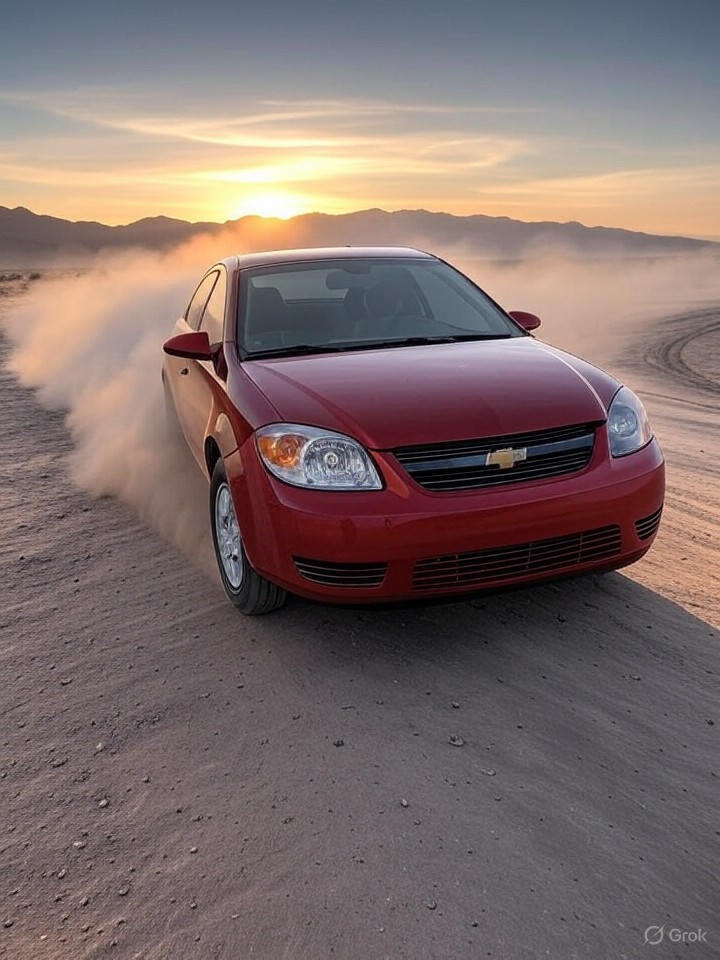
2005 Chevrolet Cobalt Sedan

2005 Chevrolet

CobaltSedan

Sedan

The 2005 Chevrolet Cobalt is a compact front-wheel-drive sedan that replaced the long-running Cavalier as GM's entry-level car. It was aimed squarely at budget-conscious commuters who needed reliable basic transportation at a low sticker price. The base powertrain is a 2.2L Ecotec four-cylinder (note: the 2.0L Ecotec turbo was reserved for the SS trim), paired with either a 5-speed manual or 4-speed automatic. The Cobalt offered a noticeably stiffer, more modern ride than the Cavalier it replaced, and its steering feel was a genuine improvement for the class. It was a high-volume seller and parts availability remains excellent today. That said, this is a 20-year-old economy car — rust, worn suspension, and deferred maintenance are the real adversaries at this age. For buyers in the Lake Geneva area, the most important consideration is corrosion. Wisconsin salt exposure over two decades can devastate the rocker panels, subframe, and brake lines on these cars. A thorough undercarriage inspection is non-negotiable before purchase.

Reliability
3/5
Verified data
Specs shown for Cobalt — the most common configuration. Other trims may vary in engine, drivetrain, or fuel economy. Sign in to see your vehicle's exact specs.
Engine
[object Object]
Drivetrain
FWD
Fuel
Premium gasoline
MPG
20 city / 27 hwy / 23 combined
Seats
Doors
Body
Subcompact Cars

Overview

AI-curated

The 2005 Chevrolet Cobalt is a compact front-wheel-drive sedan that replaced the long-running Cavalier as GM's entry-level car. It was aimed squarely at budget-conscious commuters who needed reliable basic transportation at a low sticker price. The base powertrain is a 2.2L Ecotec four-cylinder (note: the 2.0L Ecotec turbo was reserved for the SS trim), paired with either a 5-speed manual or 4-speed automatic. The Cobalt offered a noticeably stiffer, more modern ride than the Cavalier it replaced, and its steering feel was a genuine improvement for the class. It was a high-volume seller and parts availability remains excellent today. That said, this is a 20-year-old economy car — rust, worn suspension, and deferred maintenance are the real adversaries at this age. For buyers in the Lake Geneva area, the most important consideration is corrosion. Wisconsin salt exposure over two decades can devastate the rocker panels, subframe, and brake lines on these cars. A thorough undercarriage inspection is non-negotiable before purchase.

Known for
  • Affordable entry-level pricing and low running costs
  • Ecotec engine with solid long-term durability when maintained
  • Sporty SS trim with turbocharged performance (base trims are modest)
  • High parts availability due to high production volume
Best for
  • Budget-conscious commuters needing basic A-to-B transportation
  • First-time car owners or high-school/college drivers
  • Low-mileage city driving where fuel economy matters
Watch for
  • Severe rust and corrosion on rockers, subframe, and brake lines on Wisconsin examples
  • Ignition switch recall history — this model was part of a major GM recall
  • Power steering issues (electric power steering can fail on higher mileage examples)
  • Interior quality and trim pieces that rattle and break with age

Common issues by mileage

6 known

Ignition Switch Failure / Unintended Shutdown

high
Typically appears
Any mileage
Estimated repair
$150 – $400

Front Wheel Bearing Failure

high
Typically appears
80–130k mi
Estimated repair
$200 – $380

Electric Power Steering (EPS) Failure

medium
Typically appears
70–120k mi
Estimated repair
$400 – $900

Oxygen Sensor / Heater Circuit Failure

medium
Typically appears
80–150k mi
Estimated repair
$150 – $320

Undercarriage Rust — Brake Lines, Rockers, Subframe

high
Typically appears
Any mileage on Wisconsin/salt-belt vehicles
Estimated repair
$300 – $2,500

Strut and Strut Mount Wear

medium
Typically appears
90–140k mi
Estimated repair
$350 – $700

Maintenance schedule

  1. 1
    Every 5,000 miles or 6 months — do not rely solely on the oil life monitor on a 20-year-old engine Engine Oil Change

    The Ecotec 2.2L is oil-change sensitive. Sludge buildup from extended intervals shortens engine life significantly on these motors.

  2. 2
    Every fall, before winter Brake Line Inspection

    Steel brake lines on Wisconsin Cobalts are heavily susceptible to salt corrosion and can fail without warning. Inspect the full run from master cylinder to calipers.

  3. 3
    Every 5 years or 50,000 miles Coolant Flush

    DEX-COOL extended-life coolant degrades and becomes acidic if mixed with other coolants or left too long, causing intake manifold gasket and water pump issues.

  4. 4
    Every 45,000–50,000 miles Spark Plug Replacement

    The Ecotec uses iridium plugs with a finite life. Worn plugs cause misfires and can set off catalytic converter damage codes.

  5. 5
    Every 6,000–7,500 miles Tire Rotation and Wheel Bearing Check

    FWD cars wear front tires faster, and rotation extends tire life. At each rotation, check front wheel bearings by hand — early noise saves a roadside failure.

  6. 6
    Every fall, before winter Battery Test

    A 20-year-old vehicle's charging system and battery are always suspect. Wisconsin sub-zero starts will expose a weak battery immediately. Test and replace if capacity is below 70%.

  7. 7
    Every 60,000 miles or every 3 years Serpentine Belt Inspection

    Belt cracking from Wisconsin freeze-thaw cycles accelerates wear. A snapped belt disables the alternator, power steering, and water pump simultaneously.

  8. 8
    Every 2 weeks during winter road salt season Undercarriage Wash

    Salt accumulation on brake lines, subframe, and suspension is the number-one killer of Cobalts in the Midwest. Regular flushing dramatically slows corrosion.

Always defer to the manufacturer's service manual for warranty-mandated intervals.

Cost of ownership

Annual maintenance
$600 – $1,800
Fuel
At 29 MPG combined and ~15,000 miles/year, expect roughly $1,700–$2,000/year at current Wisconsin gas prices. The base engine uses regular 87 octane — no premium needed.
Insurance
Among the cheapest vehicles to insure in the compact segment. Expect $800–$1,400/year for full coverage depending on driver age and record.

The Cobalt is inexpensive to own when it's healthy, but age-related repairs on a salt-belt car can spike costs quickly. Budget the higher end of the maintenance range if you don't know the car's service history. Parts are cheap and widely available — labor is where you save by using an independent shop.
Seasonal care

Lake Geneva, WI
Winter
  • Test the battery every October — sub-zero Lake Geneva temps will kill a marginal battery on the first cold snap. Replace if capacity is under 70%.
  • Inspect and if needed replace all four brake lines before the first snowfall. This is the single most critical safety item on aged Midwest Cobalts.
  • Switch to a winter-rated washer fluid rated to at least -20°F — the Cobalt's reservoir is small and runs out fast in salt conditions.
  • Check tire tread depth; the Cobalt is a light FWD car and becomes genuinely hazardous in snow on worn all-seasons. Winter tires are strongly recommended.
  • Flush the undercarriage at a touchless car wash every 10–14 days during salting season to protect the subframe and brake lines.
  • Avoid heavy keyring loads on the ignition key — the Cobalt's ignition switch is known to be sensitive to weight, which can cause the engine to cut out unexpectedly.
Summer
  • Check tire pressure monthly — heat causes pressure to rise, and these small tires are sensitive to overinflation affecting handling.
  • Inspect the A/C system; the refrigerant charge and cabin air filter should be checked if cooling feels weak after a Wisconsin winter.
  • Inspect the coolant level and condition in May — the Ecotec runs warm and a low coolant level in summer heat can quickly cause overheating.
  • Examine rubber suspension bushings and strut mounts after winter — freeze-thaw cycles crack rubber, and summer potholes finish them off.

Comparable vehicles

If you're shopping for one

Red flags
  • Any visible rust perforation on the rocker panels or bubbling paint near the wheel arches — walk away, structural repair costs exceed the car's value.
  • Brake pedal that feels soft, spongy, or sinks slowly — corroded brake lines can fail completely and represent an immediate safety hazard.
  • A heavy keychain or multiple accessories on the ignition key — suggests the owner is unaware of the ignition switch recall risk.
  • No service records whatsoever on a high-mileage example — the Ecotec engine needs consistent oil changes and neglect shows up fast.
  • Signs of overheating history (stained overflow tank, milky oil cap) — head gasket repairs on a car this value rarely pencil out.
What to inspect
  • Full undercarriage inspection for rust on brake lines, fuel lines, subframe mounting points, and rocker panels — this is the make-or-break item on any Wisconsin Cobalt.
  • Verify the ignition switch recall (NHTSA 14V-047 and related) has been completed. Ask for documentation or check the VIN on NHTSA's recall database.
  • Test drive with the steering wheel centered at highway speed — any pull or vibration indicates wheel bearing wear or alignment issues from pothole damage.
  • Check for EPS warning light or heavy/jerky steering feel, which indicates power steering module wear.
  • Inspect the coolant for a milky or oily appearance, which can indicate a head gasket seeping on a neglected example.
  • Pull codes with an OBD-II scanner even if no check engine light is present — pending codes are common on these cars and won't always trigger the MIL.
AI profile generated 17 days ago · claude-sonnet-4-6 · v2.