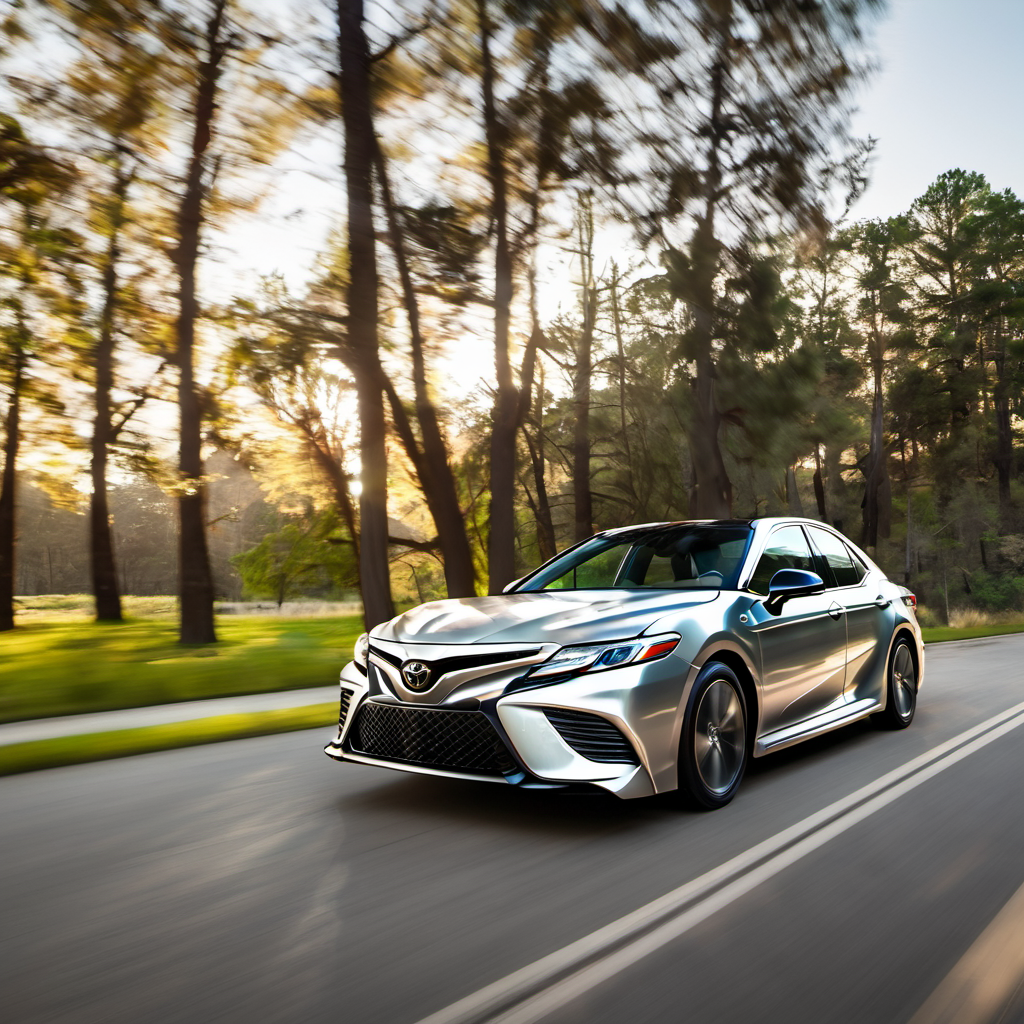
2018 Toyota Camry Sedan
Popular pick

2018 Toyota

CamrySedan

2.5L 4-cylinder · Sedan

The 2018 Toyota Camry represents a full redesign of America's best-selling sedan — the eighth generation — built on Toyota's TNGA platform. It's lower, wider, and more engaging to drive than its predecessor, with a sharper exterior, improved cabin materials, and a revised 2.5L Dynamic Force four-cylinder engine. Toyota Safety Sense P (TSS-P) is standard across all trims, making it one of the better-equipped cars for driver assistance at its price point. For daily commuting and long-haul highway driving, it's hard to beat the combination of fuel economy, interior space, and long-term dependability. The 2.5L four-cylinder paired with an 8-speed automatic is refined and efficient. The XSE and SE trims add sport tuning but sacrifice some ride comfort over Wisconsin's rougher roads. The 2018 redesign fixed many of the criticisms of the prior generation — it's more fun to drive and better looking — while keeping the reliability DNA intact. Used examples are plentiful, parts are cheap, and nearly any independent shop can work on them.

Reliability
4/5
Verified data
Specs shown for Camry — the most common configuration. Other trims may vary in engine, drivetrain, or fuel economy. Sign in to see your vehicle's exact specs.
Engine
[object Object]
Drivetrain
Front-Wheel Drive
Fuel
Gasoline
MPG
28 city / 39 highway / 32 combined
Seats
Doors
Body
Midsize Cars
MSRP
$23,955

Overview

AI-curated

The 2018 Toyota Camry represents a full redesign of America's best-selling sedan — the eighth generation — built on Toyota's TNGA platform. It's lower, wider, and more engaging to drive than its predecessor, with a sharper exterior, improved cabin materials, and a revised 2.5L Dynamic Force four-cylinder engine. Toyota Safety Sense P (TSS-P) is standard across all trims, making it one of the better-equipped cars for driver assistance at its price point. For daily commuting and long-haul highway driving, it's hard to beat the combination of fuel economy, interior space, and long-term dependability. The 2.5L four-cylinder paired with an 8-speed automatic is refined and efficient. The XSE and SE trims add sport tuning but sacrifice some ride comfort over Wisconsin's rougher roads. The 2018 redesign fixed many of the criticisms of the prior generation — it's more fun to drive and better looking — while keeping the reliability DNA intact. Used examples are plentiful, parts are cheap, and nearly any independent shop can work on them.

Known for
  • Class-leading long-term reliability
  • Smooth, fuel-efficient 2.5L four-cylinder
  • Strong resale value
  • Comfortable highway cruiser
  • Standard Toyota Safety Sense P across all trims
Best for
  • Daily commuters who want low ownership cost
  • High-mileage drivers who need fuel economy
  • First-time car buyers wanting proven dependability
  • Families needing a spacious, practical sedan
Watch for
  • Oil dilution with fuel in the 2.5L engine (reported in some early 2018 examples — monitor oil level and condition)
  • Road noise on highway can be noticeable on the base trim
  • Entune 3.0 infotainment has a learning curve and can feel laggy
  • Paint quality — light scratches easily on lower trims

Common issues by mileage

6 known

Engine oil dilution with fuel

medium
Typically appears
0–60k mi
Estimated repair
$0 – $200

VVT/VVTi system — camshaft timing over-retarded

low
Typically appears
60–120k mi
Estimated repair
$150 – $600

VVT oil control solenoid failure

low
Typically appears
60–120k mi
Estimated repair
$120 – $400

Oxygen/A/F sensor heater circuit fault

low
Typically appears
80–150k mi
Estimated repair
$150 – $450

Premature wear on front struts and mounts

medium
Typically appears
80–120k mi
Estimated repair
$400 – $900

Maintenance schedule

  1. 1
    Every 5,000 miles or 6 months Engine oil and filter change (0W-20 full synthetic)

    The 2.5L Dynamic Force engine is designed for 0W-20. Given the fuel dilution history on early 2018 units, check the oil level and smell/color at every interval — don't stretch changes.

  2. 2
    Every 5,000 miles Tire rotation

    FWD cars wear front tires faster. Regular rotation evens wear and extends tire life, especially through Wisconsin freeze-thaw road damage.

  3. 3
    Every 30,000 miles or 2 years Cabin air filter replacement

    Wisconsin road salt and debris clog the cabin filter faster than in dry climates. A dirty filter strains the HVAC blower motor.

  4. 4
    Every 30,000 miles Engine air filter inspection and replacement

    Keeps the 2.5L breathing clean; important for fuel economy and to avoid lean-condition codes.

  5. 5
    Every 60,000 miles Spark plug replacement (iridium)

    OEM iridium plugs are rated for 60k. Worn plugs can cause misfires and rough idle, and can stress the ignition coils.

  6. 6
    Every 2 years or 30,000 miles Brake fluid flush

    Brake fluid is hygroscopic — it absorbs moisture over time. In Wisconsin's road-salt environment, moisture-laden fluid accelerates corrosion in calipers and brake lines.

  7. 7
    Every 50,000 miles or 5 years Coolant system inspection and flush

    Toyota's long-life coolant holds up well, but sub-zero Wisconsin winters put real stress on the cooling system. Check freeze point every fall.

  8. 8
    Every fall before winter Inspect and treat underbody / brake components for rust

    Wisconsin road salt aggressively attacks brake lines, calipers, and the fuel/brake line routing on the undercarriage. Catching surface rust early is far cheaper than replacing lines.

Always defer to the manufacturer's service manual for warranty-mandated intervals.

Cost of ownership

Annual maintenance
$400 – $850
Fuel
At 32 MPG combined and ~15,000 miles/year, expect roughly $1,500–$1,900/year at current Midwest gas prices. Highway-heavy drivers will do better; city-heavy drivers will trend toward the higher end.
Insurance
Typically $1,000–$1,400/year for a 2018 Camry in Wisconsin for a driver with a clean record and standard coverage. Exact rates vary by zip code, driving history, and coverage level.

The 2018 Camry is one of the cheapest mid-size sedans to own over the long haul. Parts are widely available, labor costs are low at independent shops, and the drivetrain rarely needs major intervention if oil changes are kept current. The biggest unexpected costs for Wisconsin owners tend to be rust-related (brake lines, exhaust) and strut/suspension work after years of potholed roads.
Seasonal care

Lake Geneva, WI
Winter
  • Switch to winter-rated tires before temps drop below 45°F — the all-season OEM tires lose significant grip on snow and ice.
  • Test the 12V battery every fall. Cold cranking amps drop sharply below 0°F, and batteries over 4 years old are at risk.
  • Top off washer fluid with a -20°F or colder rated formula before the first freeze. The reservoir is large but empties fast when fighting road salt spray.
  • Check coolant freeze protection every October — the system should be protected to at least -35°F for Lake Geneva winters.
  • Rinse the undercarriage at a touchless car wash after every major salt event to slow brake line and suspension corrosion.
  • If the vehicle sits outside, use a remote start (available on this trim) to warm the cabin but limit idling — the 2.5L warms faster when driven gently.
Summer
  • Check tire pressure monthly — for every 10°F rise in ambient temperature, pressure increases ~1 PSI. Wisconsin summers can swing 40–50°F from spring baseline.
  • Inspect the A/C system for refrigerant charge and cabin filter condition before the first heat wave — a clogged filter kills airflow.
  • Check engine coolant level and condition; heat soak in stop-and-go traffic is harder on coolant than highway driving.
  • Inspect wiper blades — winter salt and road grit degrades blade edges. Replace before summer thunderstorm season.

Comparable vehicles

If you're shopping for one

Red flags
  • Oil that smells like gasoline or is overfull on the dipstick — indicates active fuel dilution problem.
  • Any VVT-related check engine codes (P0012, P0015, P0022, P0025) with no repair documentation.
  • Visible rust on brake lines, especially near the rear axle — a common and expensive Wisconsin-car problem.
  • No service records at all — on a FWD Camry with unknown oil change history, the VVT system is the first casualty of neglect.
  • CAN/network fault codes (U0100–U0104) with no clear diagnosis — can indicate wiring harness damage from rodents or accident repair.
What to inspect
  • Pull the oil dipstick and smell it — fuel-diluted oil smells like raw gasoline and may be overfull. This is the #1 early 2018 issue.
  • Check for service history showing regular 5,000-mile oil changes. Skipped intervals on this engine accelerate VVT sludge buildup.
  • Inspect the underbody for rust on brake lines and fuel lines — critical for any Wisconsin-wintered vehicle.
  • Test the A/C on full cold and the heat on full hot. The HVAC system is generally reliable but verify before purchase.
  • Scan for stored or pending DTCs, especially P0012/P0015 VVT timing codes — these point to sludge or worn VVT components.
  • Check all four tires for even wear. Cupped or uneven wear suggests neglected rotations or a suspension alignment issue.
AI profile generated 4 days ago · claude-sonnet-4-6 · v2.