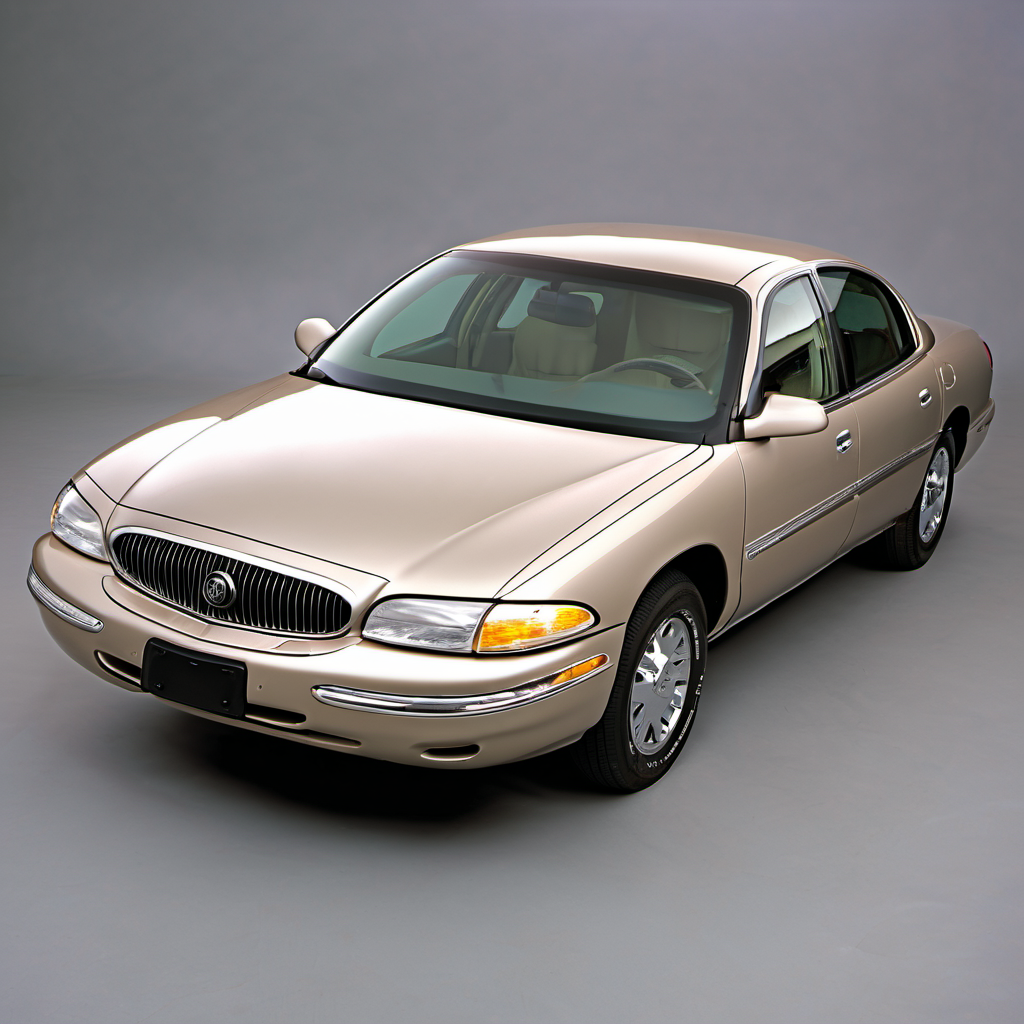
2001 Buick LeSabre Sedan

2001 Buick

LeSabreSedan

Sedan

The 2001 Buick LeSabre is a full-size, front-wheel-drive American sedan that earned a loyal following among buyers who wanted genuine comfort, proven reliability, and a quiet ride without the cost of a luxury import. Powered exclusively by GM's bulletproof 3800 Series II V6, it was one of the most dependable engines of its era — many LeSabres have crossed 200k miles with little more than basic maintenance. The LeSabre sits at the top of the traditional American comfort-car segment. Cabin noise is minimal, the ride is soft and controlled, and the interior is roomy enough for four adults to travel in genuine comfort. Features like heated seats, automatic climate control, and a trunk large enough to swallow luggage for a road trip were standard or near-standard by 2001. At this age (20+ years), condition varies widely. A well-maintained example is still a cost-effective, reliable daily driver. A neglected one can develop cooling system, intake manifold gasket, and suspension bushing problems that add up fast. Buy on documented maintenance history, not price alone.

Reliability
4/5
Verified data
Specs shown for LeSabre — the most common configuration. Other trims may vary in engine, drivetrain, or fuel economy. Sign in to see your vehicle's exact specs.
Engine
[object Object]
Drivetrain
FWD
Fuel
Gasoline
MPG
17 city / 27 hwy / 20 combined
Seats
Doors
Body
Large Cars

Overview

AI-curated

The 2001 Buick LeSabre is a full-size, front-wheel-drive American sedan that earned a loyal following among buyers who wanted genuine comfort, proven reliability, and a quiet ride without the cost of a luxury import. Powered exclusively by GM's bulletproof 3800 Series II V6, it was one of the most dependable engines of its era — many LeSabres have crossed 200k miles with little more than basic maintenance. The LeSabre sits at the top of the traditional American comfort-car segment. Cabin noise is minimal, the ride is soft and controlled, and the interior is roomy enough for four adults to travel in genuine comfort. Features like heated seats, automatic climate control, and a trunk large enough to swallow luggage for a road trip were standard or near-standard by 2001. At this age (20+ years), condition varies widely. A well-maintained example is still a cost-effective, reliable daily driver. A neglected one can develop cooling system, intake manifold gasket, and suspension bushing problems that add up fast. Buy on documented maintenance history, not price alone.

Known for
  • GM 3800 Series II V6 — one of the most durable domestic engines ever built
  • Exceptionally smooth, quiet highway ride
  • Generous trunk and rear-seat legroom for a sedan
  • Strong resale longevity among older-generation loyal Buick buyers
Best for
  • Retirees and highway commuters prioritizing comfort and low operating cost
  • Budget-conscious buyers wanting a roomy, reliable used sedan
  • Owners who perform or closely track their own maintenance
  • Long-distance driving with minimal fatigue
Watch for
  • Intake manifold gasket failure — the single most common expensive repair on the 3800
  • Coolant leaks that go unnoticed until overheating occurs
  • Power window regulator failures — very common at this age
  • Aged rubber bushings and strut mounts on high-mileage examples
  • Deferred maintenance from prior owners — always get a pre-purchase inspection

Common issues by mileage

6 known

Intake Manifold Gasket Failure (Lower)

high
Typically appears
60–120k mi
Estimated repair
$400 – $750

Coolant Reservoir / Upper Radiator Hose Failure

high
Typically appears
80–150k mi
Estimated repair
$100 – $300

Power Window Regulator Failure

high
Typically appears
80–180k mi
Estimated repair
$150 – $350

Front Strut / Strut Mount Wear

medium
Typically appears
100–160k mi
Estimated repair
$400 – $800

O2 Sensor / Heater Circuit Failure

medium
Typically appears
80–150k mi
Estimated repair
$150 – $350

Maintenance schedule

  1. 1
    Every 2 years or 30k miles Coolant flush and system inspection

    The 3800's intake manifold gaskets are made of a plastic/rubber composite that degrades in old or acidic coolant. Keeping fresh Dex-Cool (or switching to universal green coolant) significantly extends gasket life. Always pressure-test the system.

  2. 2
    Every 60k miles or at first sign of cracking/glazing Inspect and replace serpentine belt and tensioner

    A snapped belt on the 3800 kills power steering, alternator, and cooling fan simultaneously. The tensioner weakens with age and should be replaced with the belt.

  3. 3
    Every 30–40k miles on used examples Transmission fluid change

    The 4T65-E automatic is durable but sensitive to degraded fluid. Many used LeSabres have never had a trans service — fresh fluid and a new filter adds years of life.

  4. 4
    Every 60k miles (platinum plugs); wires every 60–80k Spark plugs and plug wires

    The 3800 uses a distributorless ignition system. Worn wires cause misfires and rough cold starts. On a used car, replace both if history is unknown.

  5. 5
    Annually Inspect power steering hoses and rack boots

    Hoses harden and crack with age, causing slow leaks. Wisconsin road salt accelerates corrosion on rack fittings.

  6. 6
    Every fall before winter Battery load test

    The 3800 starts easily when healthy, but a marginal battery fails fast at sub-zero temps. Lake Geneva winters are hard on batteries — test and replace proactively if over 4 years old.

  7. 7
    Annually, especially undercarriage Inspect brake lines and fuel lines for rust

    Wisconsin road salt corrodes brake lines from the outside. On a 20+ year old car, rusty brake lines are a real safety issue — inspect the full run every year.

  8. 8
    Every 40–50k miles PCV valve replacement

    A clogged PCV on the 3800 causes sludge buildup and pressurizes the crankcase, accelerating intake and valve cover gasket leaks.

Always defer to the manufacturer's service manual for warranty-mandated intervals.

Cost of ownership

Annual maintenance
$600 – $1,400
Fuel
At 20 MPG combined and $3.50/gal, expect roughly $1,750–$2,100/year at 10,000–12,000 miles annually. Highway driving (common for this car) will do better, closer to 27 MPG.
Insurance
Typically $700–$1,100/year for a 20+ year old sedan with full coverage in the Lake Geneva area. Liability-only drops closer to $400–$600.

The LeSabre is one of the cheapest full-size sedans to own in this price range. Parts are plentiful, labor is straightforward, and most independent shops know the 3800 well. The main budget risk is deferred maintenance catching up — a cooling system overhaul or intake gasket job can run $500–$750. Budget for it proactively rather than reactively.
Seasonal care

Lake Geneva, WI
Winter
  • Load-test the battery every October — sub-zero temps in Lake Geneva will kill a weak battery without warning. Replace anything under 400 CCA or 4+ years old.
  • Switch to a winter-rated washer fluid rated to at least -20°F. The reservoir freezes quickly with summer fluid and can crack the pump.
  • Inspect wiper blades before first snow and consider winter-specific blades — the flat-blade style handles ice buildup better than standard frames.
  • Apply undercarriage rinse every 2–3 weeks during salting season. The LeSabre's aging brake lines, wheel well seams, and subframe are all salt targets.
  • Keep the fuel tank above half when temperatures drop below 0°F to reduce moisture condensation in the tank and fuel lines.
  • Allow the engine to idle 30–60 seconds before driving in extreme cold — the 3800 oil is thick at startup and the intake manifold gaskets benefit from gradual warm-up.
Summer
  • Check tire pressure monthly — for every 10°F rise in ambient temp, pressure increases roughly 1 PSI. Start from the correct cold baseline to avoid overinflation.
  • Inspect the A/C system performance in spring. The LeSabre's dual-zone climate control is a comfort feature — a failing compressor or low refrigerant ruins highway trips. R-134a recharge runs $80–$150 at an independent shop.
  • Monitor coolant temperature closely in stop-and-go traffic. At 20+ years, a marginal thermostat or clogged radiator that copes fine in winter can push temps into the danger zone on a hot July day.
  • Inspect the coolant reservoir for discoloration, oil sheen, or low level — early signs of the intake manifold gasket starting to seep.

Comparable vehicles

If you're shopping for one

Red flags
  • Any evidence of coolant in the oil or oil in the coolant — intake manifold gasket failure that may have caused overheating damage.
  • White smoke from the exhaust at operating temperature — possible head gasket involvement if the intake gasket went unrepaired.
  • Rust-through on brake lines, fuel lines, or structural subframe areas — a safety issue that can cost more than the car is worth to fix.
  • No maintenance records whatsoever on a high-mileage example — unknown fluid and gasket history on the 3800 is a genuine risk.
  • Transmission that slips, hunts between gears, or has delayed engagement — 4T65-E rebuilds run $1,500–$2,500 at an independent shop.
  • Musty interior smell combined with wet carpet — a common sign of a leaking windshield or door seal that has caused floor pan rust.
What to inspect
  • Pull the oil dipstick and look for a milky or caramel-colored residue — a telltale sign of coolant mixing from a failed intake manifold gasket.
  • Check the coolant reservoir for an oily film on top of the coolant — same warning as above.
  • Run the engine to full operating temp and watch the temperature gauge — it should stabilize in the middle. Any creeping toward hot indicates thermostat, water pump, or cooling system issues.
  • Test every power window — all four. Regulator failures are common and each repair is $150–$350.
  • Inspect the undercarriage and wheel wells for rust on brake lines, fuel lines, and the subframe. Surface rust is expected; perforated lines or structural rust are deal-breakers.
  • Check all four tires for even wear — cupped or feathered tires signal worn struts or alignment issues.
  • Scan for active and stored DTCs before purchase. Codes related to O2 sensors (P0030–P0036) and ABS sensors (C0060–C0080) are common on aging examples but should be disclosed and priced into the deal.
AI profile generated 6 days ago · claude-sonnet-4-6 · v2.