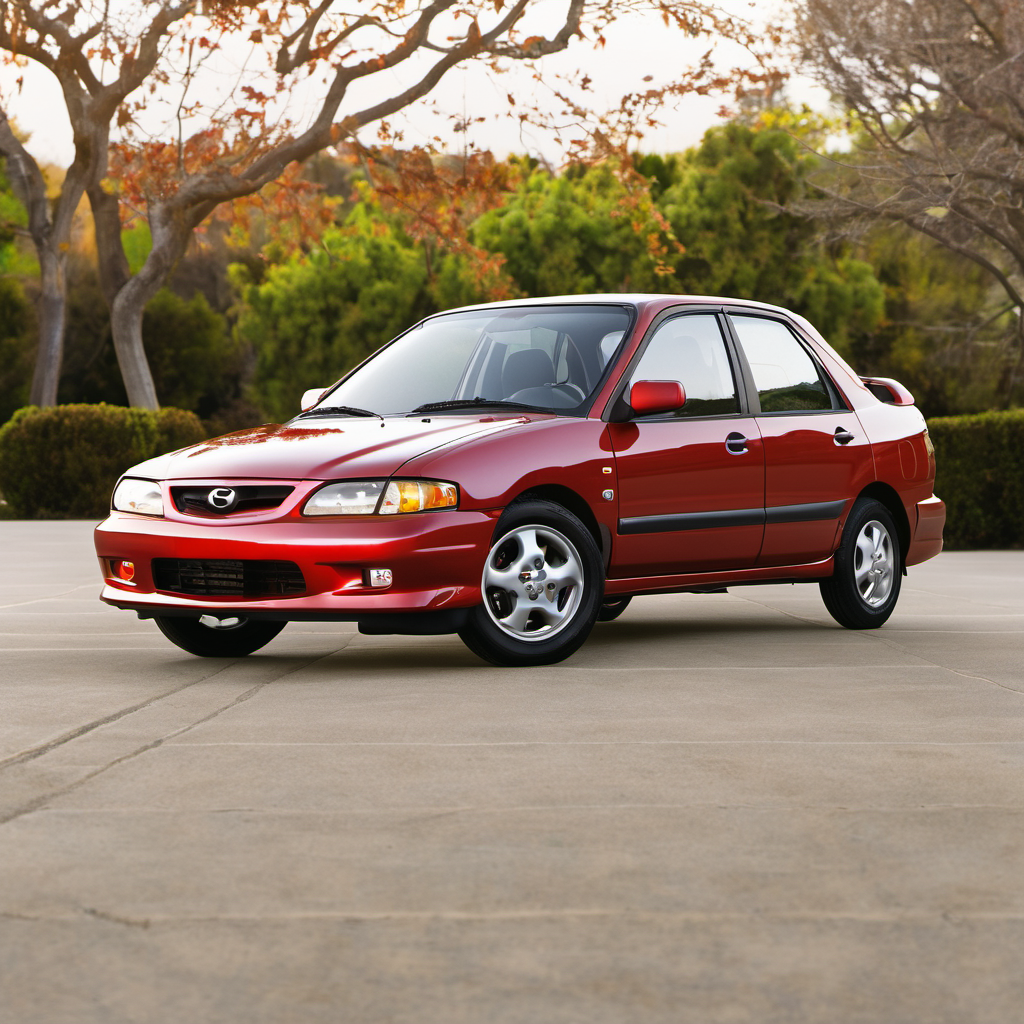
1999 MAZDA Protege Sedan

1999 MAZDA

ProtegeSedan

Sedan

The 1999 Mazda Protege is a compact front-wheel-drive sedan that earned a strong following for being reliable, fun to drive, and cheap to own. It sits in the second generation of the BJ-body Protege, which Mazda refreshed for 1999 with slightly updated styling and improved interior quality. Under the hood, the base DX and LX trims carried a 1.6L four-cylinder, while the ES got a 1.8L — this record reflects the 1.6L configuration. The Protege punches above its weight in the driving dynamics department. The chassis is composed and communicative for a budget compact, which made it a sleeper favorite among enthusiasts. Fuel economy is solid for the era, and parts availability remains reasonable because many components were shared across Mazda's lineup and with some Ford platforms. At 25+ years old, any surviving Protege is either a well-cared-for survivor or a tired daily driver that's been patched along. Rust is the single biggest threat in Wisconsin — the floor pans, rear wheel arches, and subframe mounting points are where these cars rot first. A mechanically sound, rust-free example is still worth owning.

Reliability
4/5
Verified data
Specs shown for Protege — the most common configuration. Other trims may vary in engine, drivetrain, or fuel economy. Sign in to see your vehicle's exact specs.
Engine
[object Object]
Drivetrain
FWD
Fuel
Gasoline
MPG
23 city / 30 hwy / 26 combined
Seats
Doors
Body
Compact Cars

Overview

AI-curated

The 1999 Mazda Protege is a compact front-wheel-drive sedan that earned a strong following for being reliable, fun to drive, and cheap to own. It sits in the second generation of the BJ-body Protege, which Mazda refreshed for 1999 with slightly updated styling and improved interior quality. Under the hood, the base DX and LX trims carried a 1.6L four-cylinder, while the ES got a 1.8L — this record reflects the 1.6L configuration. The Protege punches above its weight in the driving dynamics department. The chassis is composed and communicative for a budget compact, which made it a sleeper favorite among enthusiasts. Fuel economy is solid for the era, and parts availability remains reasonable because many components were shared across Mazda's lineup and with some Ford platforms. At 25+ years old, any surviving Protege is either a well-cared-for survivor or a tired daily driver that's been patched along. Rust is the single biggest threat in Wisconsin — the floor pans, rear wheel arches, and subframe mounting points are where these cars rot first. A mechanically sound, rust-free example is still worth owning.

Known for
  • Sharp, engaging handling for a budget compact
  • Frugal fuel economy and low running costs
  • Durable 1.6L and 1.8L four-cylinder engines
  • Affordable and widely available parts
Best for
  • Budget-conscious commuters who want a reliable daily driver
  • First-time car owners learning basic maintenance
  • Drivers who prioritize fuel economy over cargo space
  • Enthusiasts looking for an inexpensive, fun-to-drive platform
Watch for
  • Significant rust on floor pans, rocker panels, and subframe in salt-belt states like Wisconsin
  • High-mileage timing belt neglect — this is an interference engine
  • Worn or collapsed engine and transmission mounts at high miles
  • Aging rubber: coolant hoses, belts, and suspension bushings deteriorate with age regardless of mileage

Common issues by mileage

6 known

Timing Belt Failure (Interference Engine Risk)

high
Typically appears
60–100k mi, then every 60k
Estimated repair
$350 – $600

Rust — Floor Pans, Rocker Panels, Rear Wheel Arches, Subframe

high
Typically appears
Any mileage on salt-belt vehicles
Estimated repair
$500 – $3,500

Engine and Transmission Mount Wear

high
Typically appears
80k–150k mi
Estimated repair
$150 – $400

Coolant Hose and Thermostat Deterioration

high
Typically appears
Any vehicle over 15 years old
Estimated repair
$80 – $250

Brake Master Cylinder and Caliper Seizing

medium
Typically appears
80k+ mi, age-dependent
Estimated repair
$150 – $450

Maintenance schedule

  1. 1
    Every 60,000 miles or 5 years, whichever comes first Timing belt and water pump replacement

    The 1.6L is an interference engine — if the timing belt snaps, valves and pistons collide and the engine is totaled. Always replace the water pump at the same time since the labor is shared. On a 1999 with unknown history, do it now regardless of mileage.

  2. 2
    Every 5,000 miles or 6 months Engine oil change

    The BP-series 1.6L is tolerant of regular oil but hates neglect. Old, degraded oil accelerates cam and valve train wear. Use the shorter interval for a 25-year-old engine.

  3. 3
    Every 2 years or 30,000 miles Coolant flush and hose inspection

    Rubber hoses and the radiator are age-compromised on any 1999 vehicle. Degraded coolant becomes acidic and attacks the aluminum head and water pump. Check hoses for soft spots, cracks, and swelling at every oil change.

  4. 4
    Every 2 years Brake fluid flush

    Brake fluid is hygroscopic and absorbs moisture over time, lowering its boiling point and corroding brake hydraulics from the inside. On a car this age, fresh fluid also helps prevent caliper and wheel cylinder seizure.

  5. 5
    Every 30,000 miles Spark plugs and ignition wires

    Worn plugs and cracked wires cause misfires, rough idle, and poor fuel economy. At this vehicle's age, wires are likely original or at least many years old — inspect and replace as a set.

  6. 6
    Annually or at every tire rotation Suspension and steering bushing inspection

    At 25+ years, rubber bushings crack and deteriorate from age and Wisconsin salt exposure, causing vague steering and clunking. Control arm bushings and sway bar end links are the first to go.

  7. 7
    Every spring after winter Underbody rust inspection

    Wisconsin road salt attacks exposed metal year-round. Catch rust on rocker panels, floor pans, and subframe mounting points early — surface rust treated promptly costs far less than structural rust repair or condemnation.

  8. 8
    Every 15,000–20,000 miles Air filter replacement

    A clogged air filter robs the 1.6L of power and fuel economy. Easy and inexpensive — no reason to skip it.

Always defer to the manufacturer's service manual for warranty-mandated intervals.

Cost of ownership

Annual maintenance
$400 – $900
Fuel
At ~26 MPG combined and typical Wisconsin driving, expect roughly $1,200–$1,600/year at current fuel prices depending on how much highway vs. city driving you do.
Insurance
Liability-only coverage for a vehicle this age and value typically runs $400–$700/year in the Lake Geneva area for a standard driver profile. Full coverage rarely makes financial sense at this vehicle's market value.

The Protege is genuinely cheap to own when it's healthy. Parts are affordable, the engine is simple, and independent shops can work on it easily. The cost wildcard is rust — a structural rust repair or floor pan replacement can exceed the car's market value overnight. Budget for that inspection before buying and annually afterward.
Seasonal care

Lake Geneva, WI
Winter
  • Test the battery before first hard freeze — a 25-year-old charging system should be inspected and the battery load-tested; cold cranking amps drop sharply below 0°F.
  • Switch to a full-synthetic 5W-30 oil if not already using one — it flows immediately at sub-zero temps, protecting the engine on cold starts.
  • Fill the washer fluid reservoir with a rated -20°F or colder solution; Lake Geneva regularly sees sub-zero wind chills that will crack standard fluid in the lines.
  • Inspect the antifreeze concentration — it should protect to at least -34°F; use a refractometer or inexpensive test strips to verify.
  • Undercoat or rinse the undercarriage regularly after salt events — this car's floor pans and subframe are prime rust targets and salt accumulation accelerates rot fast.
  • Keep the fuel tank above half when possible — it reduces moisture condensation in the tank and ensures you won't be stranded if you need to run the heater in a cold weather emergency.
Summer
  • Check tire pressure monthly — pressure drops roughly 1 PSI for every 10°F drop in temperature, so tires inflated in winter will be underinflated by spring; summer heat reverses this and can over-inflate if not monitored.
  • Inspect the cooling system thoroughly before summer heat arrives — a 1999 Protege with original or aging hoses and a marginal thermostat will overheat in traffic; verify coolant level, hose condition, and radiator cap integrity.
  • Test A/C operation early in the season — refrigerant leaks in aged systems are common; a system that barely cools in May will fail completely in July.
  • Check the serpentine/accessory belt for cracking and glazing — summer heat accelerates belt degradation, and a snapped belt kills charging and cooling simultaneously.

Comparable vehicles

If you're shopping for one

Red flags
  • Any soft spots, bubbling paint, or visible holes in the floor pans or rockers — walk away, structural rust on a 25-year-old compact is rarely worth repairing.
  • No timing belt records and a seller who can't or won't document service history.
  • Blue smoke on startup (worn valve seals or rings) or white smoke at operating temperature (head gasket).
  • Clunking or grinding when turning at low speed — indicates worn CV axles or front strut bearings.
  • Oil that looks milky or has a burnt smell — coolant intrusion or severe overheating history.
  • Asking price near or above $3,000 — at this age and mileage range, market value rarely justifies that; overpaying leaves no margin for inevitable repairs.
What to inspect
  • Crawl under the car and inspect the floor pans, rocker panels, rear subframe mounting points, and spare tire well for rust perforation — this is the make-or-break inspection on any Wisconsin Protege.
  • Verify timing belt service history; if unknown, budget $400–$600 to do it immediately. Ask for receipts.
  • Start the engine cold and listen for ticking or rattling from the valve train — indicates low oil pressure, worn cam followers, or a loose timing belt tensioner.
  • Check all four brake calipers for seizing and uneven pad wear; aging hydraulic components are common on vehicles this old.
  • Inspect all coolant hoses by squeezing them — they should feel firm but pliable, not spongy, hard, or cracked near the clamps.
  • Test the A/C, heater, and defroster — HVAC repairs on a car this age can cost more than the vehicle's value.
AI profile generated 15 days ago · claude-sonnet-4-6 · v2.