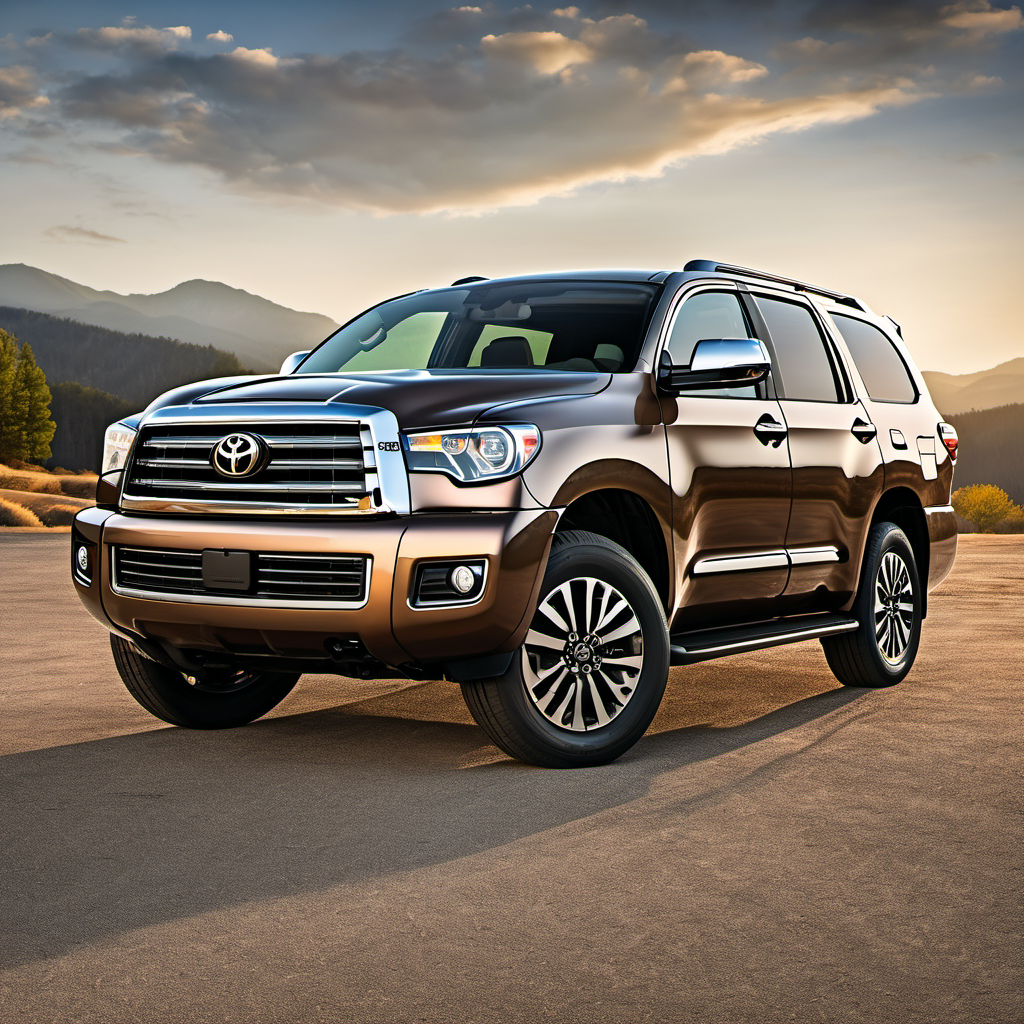
2019 Toyota Sequoia SUV

2019 Toyota

SequoiaSUV

SUV

The 2019 Toyota Sequoia is a full-size body-on-frame SUV built on the same Tundra platform that has been largely unchanged since 2008. It seats up to eight passengers and is powered by Toyota's proven 5.7L i-FORCE V8, making it one of the most mechanically simple and durable trucks in its class. While it won't win any awards for fuel economy or cutting-edge technology, it remains a go-to choice for families who need serious towing capability and the confidence of Toyota's long-term reliability record. By 2019, the Sequoia's platform was over a decade old, and that shows in the infotainment system and interior refinement compared to American competitors. However, that same maturity means the mechanical bugs were worked out long ago and independent shops know this platform well. Parts are widely available and repair costs are predictable. For Lake Geneva-area buyers, the Sequoia's high ground clearance (9.6 in), available 4WD, and robust drivetrain make it a capable winter vehicle. The tradeoff is fuel cost — at 15 MPG combined, expect to spend significantly more at the pump than in a crossover or half-ton with a V6.

Reliability
4/5
Verified data
Specs shown for Sequoia 2WD — the most common configuration. Other trims may vary in engine, drivetrain, or fuel economy. Sign in to see your vehicle's exact specs.
Engine
[object Object]
Drivetrain
RWD
Fuel
Gasoline
MPG
13 city / 17 hwy / 15 combined
Seats
Doors
Body
Standard Sport Utility Vehicle 2WD
Length
205.1 inches

Overview

AI-curated

The 2019 Toyota Sequoia is a full-size body-on-frame SUV built on the same Tundra platform that has been largely unchanged since 2008. It seats up to eight passengers and is powered by Toyota's proven 5.7L i-FORCE V8, making it one of the most mechanically simple and durable trucks in its class. While it won't win any awards for fuel economy or cutting-edge technology, it remains a go-to choice for families who need serious towing capability and the confidence of Toyota's long-term reliability record. By 2019, the Sequoia's platform was over a decade old, and that shows in the infotainment system and interior refinement compared to American competitors. However, that same maturity means the mechanical bugs were worked out long ago and independent shops know this platform well. Parts are widely available and repair costs are predictable. For Lake Geneva-area buyers, the Sequoia's high ground clearance (9.6 in), available 4WD, and robust drivetrain make it a capable winter vehicle. The tradeoff is fuel cost — at 15 MPG combined, expect to spend significantly more at the pump than in a crossover or half-ton with a V6.

Known for
  • 5.7L i-FORCE V8 that regularly reaches 200,000+ miles
  • Strong towing capacity (7,400 lbs) for a full-size SUV
  • High ground clearance and available 4WD for all-season confidence
  • Spacious three-row seating for up to 8 passengers
  • Long-running platform with well-understood maintenance needs
Best for
  • Families needing 7–8 seats and regular towing duty
  • Buyers prioritizing long-term reliability over tech features
  • Wisconsin winters and rural/off-pavement use
  • High-mileage ownership with predictable repair costs
  • Towing boats, campers, or trailers up to 7,400 lbs
Watch for
  • Secondary air injection pump failure — common and expensive (~$1,500)
  • Water pump failure can cause overheating and engine damage if ignored
  • Frame and undercarriage rust in salt-belt states like Wisconsin
  • Outdated infotainment system compared to 2019 competitors
  • Poor fuel economy — budget for it before you buy

Common issues by mileage

6 known

Secondary Air Injection Pump Failure

high
Typically appears
70–100k mi
Estimated repair
$1,200 – $1,800

Water Pump Failure

medium
Typically appears
90–120k mi
Estimated repair
$600 – $1,000

Random/Multiple Cylinder Misfire

low
Typically appears
90–120k mi
Estimated repair
$200 – $500

Transmission Rough Shifting / Hesitation

low
Typically appears
60–100k mi
Estimated repair
$200 – $3,500

VVT-i / Camshaft Timing System Issues

medium
Typically appears
80–150k mi
Estimated repair
$300 – $900

Frame and Undercarriage Rust (Salt Belt)

high
Typically appears
Any — worsens with age
Estimated repair
$500 – $3,000

Maintenance schedule

  1. 1
    Every 5,000 miles or 6 months Engine Oil Change

    This 5.7L V8 takes 7.4 quarts of 0W-20 full synthetic. Staying on schedule protects the VVT-i system, which is oil-pressure dependent — dirty oil accelerates timing wear and can trigger camshaft codes.

  2. 2
    Every 60,000 miles Transmission Fluid Change (Toyota WS ATF)

    Toyota lists this as a 'lifetime' fluid, but real-world experience — especially with towing — shows fluid breakdown well before that. Fresh WS ATF at 60k intervals prevents the rough shifting complaints common on high-mileage examples.

  3. 3
    Every 50,000 miles or 5 years Coolant System Inspection and Flush

    Water pump failure is a known issue on this platform. At each coolant service, inspect the water pump for seepage at the weep hole. Catching it early is a $600–$800 fix; ignoring it can mean an overheated engine.

  4. 4
    Every 5,000 miles Tire Rotation

    The Sequoia's rear-biased weight distribution causes uneven wear on the rear tires. Rotating with every oil change maximizes tire life and keeps handling predictable, especially important in winter driving.

  5. 5
    Every 30,000 miles or 3 years Air Filter Replacement

    A dirty air filter on a large-displacement V8 robs noticeable performance and can contribute to misfires. With Wisconsin road dust and debris, don't stretch this interval.

  6. 6
    Every 30,000 miles or 3 years Cabin Air Filter Replacement

    Keeps the HVAC system airflow strong. Particularly important for defrost performance in Wisconsin winters — a clogged cabin filter reduces defroster effectiveness.

  7. 7
    Every 30,000 miles, or if submerged in water Differential and Transfer Case Fluid Service

    The rear differential requires 75W-85 GL-5 with LSD additive if equipped. Skipping this leads to chatter and premature wear in the limited-slip. The transfer case takes 75W GL-4 — do not cross-contaminate fluid types.

  8. 8
    Every 2–3 years regardless of mileage Brake Fluid Flush

    DOT 3 fluid is hygroscopic and absorbs moisture over time. Wisconsin winters with heavy brake use on salted roads make fresh, dry fluid especially important for consistent pedal feel and corrosion prevention in the ABS system.

Always defer to the manufacturer's service manual for warranty-mandated intervals.

Cost of ownership

Annual maintenance
$600 – $1,200
Fuel
At 15 MPG combined and ~15,000 miles/year, expect roughly 1,000 gallons of premium-recommended regular fuel annually. At $3.30/gal that's about $3,300/year — budget $2,800–$4,000 depending on fuel prices and driving mix.
Insurance
Full-size SUV insurance in Walworth County typically runs $1,400–$2,000/year for a driver with a clean record, depending on coverage level and household.

The Sequoia's running costs break down into three buckets: routine maintenance is reasonable ($600–$1,200/yr at an independent shop), fuel is the biggest ongoing expense (~$3,000–$4,000/yr), and occasional major repairs — most predictably the air injection pump and water pump — can add $800–$1,800 in any given year. Over a 5-year window, plan for total ownership costs (excluding insurance) of roughly $25,000–$35,000 including fuel. The payoff is a vehicle that holds its value well and is unlikely to strand you.

Seasonal care

Lake Geneva, WI
Winter
  • Undercoat the frame and undercarriage annually before first snowfall — Wisconsin road salt is aggressive on body-on-frame trucks, and frame rust is the Sequoia's single biggest long-term threat in this region.
  • Switch to winter tires if you run the 4WD configuration. The Sequoia's weight gives it momentum advantages, but stopping distance is still governed by tire grip.
  • Test the battery before November. A 5,730-lb truck with a big V8 draws significant cranking amps in sub-zero temps; batteries over 4 years old should be load-tested.
  • Use a washer fluid rated to at least -20°F. The Sequoia's tall windshield catches a lot of highway spray and road salt mist.
  • Check that the 4WD engagement (4HI/4LO) operates correctly before winter — don't discover a stuck transfer case actuator during the first ice storm.
  • Replace wiper blades with winter-rated beam blades; the tall windshield is vulnerable to streaking from worn blades in freezing rain.
Summer
  • Inspect the A/C compressor and belt before summer heat — AC compressor failure is a known issue on high-mileage examples, and compressor seizure can take out the serpentine belt.
  • Check coolant level and condition before hot weather; the water pump's known failure window overlaps with high-load summer driving (towing, hauling) when the cooling system is most stressed.
  • Monitor tire pressure weekly in summer — the Sequoia's large tires can see 4–6 PSI swings between cold Wisconsin mornings and afternoon heat, affecting both fuel economy and handling.
  • If towing a boat or camper, ensure the transmission fluid was changed recently. Towing in summer heat is the fastest way to degrade old WS ATF.
  • Clean out road salt deposits from brake calipers and rotors in spring — residual salt accelerates corrosion and can cause uneven braking by mid-summer.

Comparable vehicles

If you're shopping for one

Red flags
  • Any frame rust that goes beyond surface oxidation — perforation is not repairable economically on a body-on-frame vehicle.
  • Check engine light on or recently cleared codes with unset readiness monitors (emissions inspection issue in Wisconsin).
  • Coolant smell inside the cabin or visible white smoke from the exhaust — indicates head gasket or water pump failure in progress.
  • Transmission fluid that is dark brown or smells burnt — indicates overheating from towing abuse or missed service.
  • Oil that is black and thick well before a service interval — points to extended oil change intervals, which degrades the VVT-i system.
What to inspect
  • Pull the underbody and frame with a flashlight — look for rust perforation at the frame rails, crossmembers, and fuel line brackets. Surface rust is normal; deep pitting or holes is a deal-breaker.
  • Scan for check engine codes before purchase, specifically any air injection system codes. A cleared code history with no readiness monitors is a red flag for hidden emissions issues.
  • With the engine warm, check for coolant weeping at the water pump snout (front of the engine, passenger side). Any residue or dried coolant staining means it's leaking.
  • Test 4WD engagement through all modes (2HI, 4HI, 4LO) in a parking lot. Listen for grinding or delay in engagement.
  • Check the transmission for smooth, crisp shifts through all gears under light and moderate acceleration. Hesitation between 2nd and 3rd is the most commonly reported rough-shift zone.
  • Verify service records for oil changes and transmission fluid. A Sequoia with no documented maintenance history above 80k miles is a risk.
AI profile generated 4 days ago · claude-sonnet-4-6 · v2.