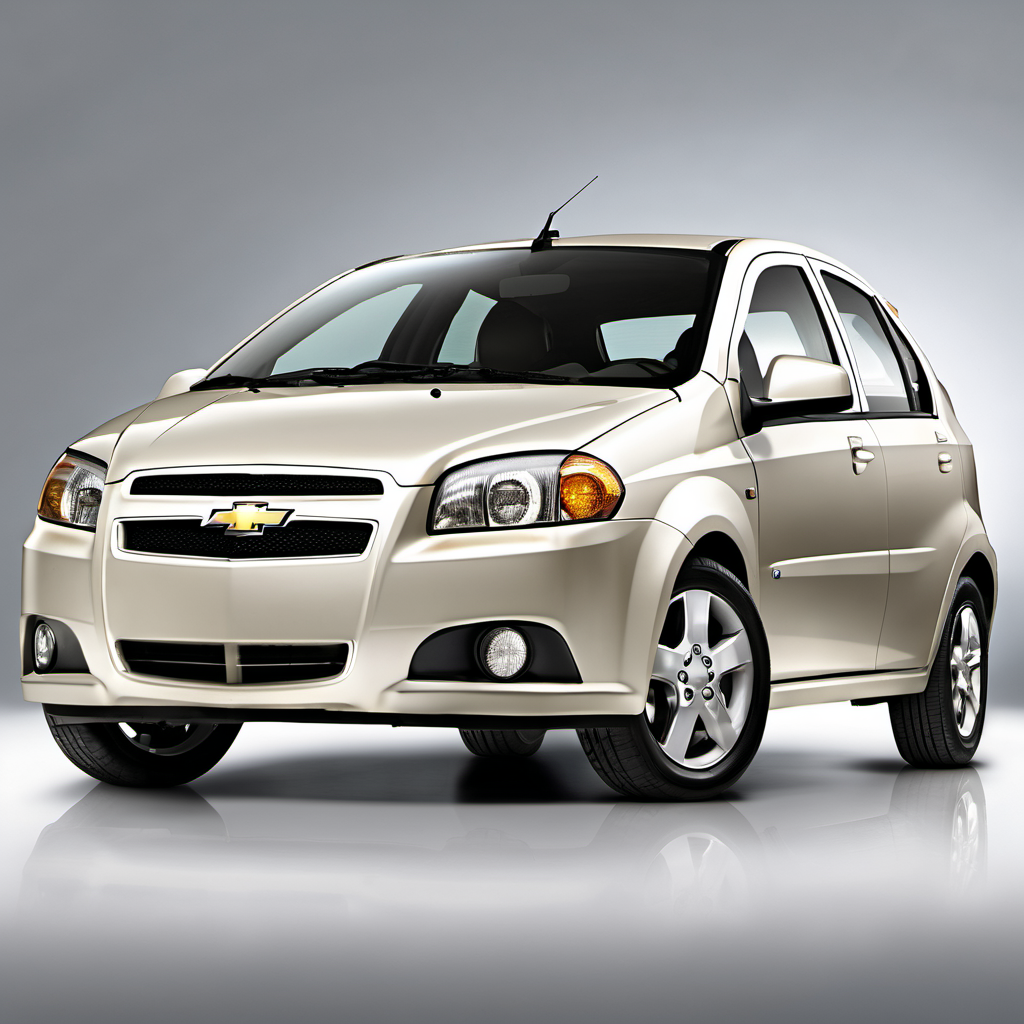
2010 Chevrolet Aveo Sedan

2010 Chevrolet

AveoSedan

Sedan

The 2010 Chevrolet Aveo Sedan is a subcompact economy car sold under the Chevrolet badge but developed by Daewoo (GM Korea). It was aimed squarely at budget-conscious buyers who needed basic, affordable transportation with low fuel costs. It was never a prestige vehicle, and GM never pretended otherwise — you're getting entry-level everything in exchange for a low purchase price and decent fuel economy. The Aveo uses a 1.6L four-cylinder paired with either a 5-speed manual or 4-speed automatic. Performance is modest at best — merging onto highways requires planning, and the 4-speed automatic can feel strained at highway speeds. Ride quality is acceptable in town but gets choppy on rough roads. Cabin materials are hard plastics throughout. By 2010, the Aveo had a reasonably sorted-out reputation for basic reliability on low to moderate mileage, but it's not a high-mileage survivor like a Honda Fit or Toyota Yaris. Budget for more frequent repairs as miles climb. The car was discontinued after 2011 and replaced by the Sonic, which addressed most of the Aveo's weaknesses.

Reliability
2/5
Verified data
Specs shown for Aveo 5 — the most common configuration. Other trims may vary in engine, drivetrain, or fuel economy. Sign in to see your vehicle's exact specs.
Engine
[object Object]
Drivetrain
FWD
Fuel
Gasoline
MPG
25 city / 34 hwy / 28 combined
Seats
Doors
Body
Subcompact Cars

Overview

AI-curated

The 2010 Chevrolet Aveo Sedan is a subcompact economy car sold under the Chevrolet badge but developed by Daewoo (GM Korea). It was aimed squarely at budget-conscious buyers who needed basic, affordable transportation with low fuel costs. It was never a prestige vehicle, and GM never pretended otherwise — you're getting entry-level everything in exchange for a low purchase price and decent fuel economy. The Aveo uses a 1.6L four-cylinder paired with either a 5-speed manual or 4-speed automatic. Performance is modest at best — merging onto highways requires planning, and the 4-speed automatic can feel strained at highway speeds. Ride quality is acceptable in town but gets choppy on rough roads. Cabin materials are hard plastics throughout. By 2010, the Aveo had a reasonably sorted-out reputation for basic reliability on low to moderate mileage, but it's not a high-mileage survivor like a Honda Fit or Toyota Yaris. Budget for more frequent repairs as miles climb. The car was discontinued after 2011 and replaced by the Sonic, which addressed most of the Aveo's weaknesses.

Known for
  • Very low purchase and insurance costs
  • Decent city fuel economy for the era
  • Simple, easy-to-work-on engine
Best for
  • First-time car buyers on a tight budget
  • Short urban commuters under 15,000 miles/year
  • Buyers looking for the cheapest possible reliable transportation
Watch for
  • Aging timing belt — failure is engine-destructive
  • Transmission longevity on the 4-speed automatic
  • Rust on rocker panels, wheel arches, and underbody in Wisconsin climates
  • Limited parts availability as the platform ages out

Common issues by mileage

6 known

Timing Belt Failure / Wear

high
Typically appears
60–100k mi
Estimated repair
$350 – $600

Oxygen Sensor Heater Circuit Failure

medium
Typically appears
80–130k mi
Estimated repair
$150 – $350

4-Speed Automatic Transmission Slipping / Failure

medium
Typically appears
100–150k mi
Estimated repair
$1,200 – $2,800

Rocker Panel and Underbody Rust

high
Typically appears
60k+ mi (age-dependent in salt states)
Estimated repair
$300 – $1,500

Intake / Exhaust Valve Control Solenoid Circuit Faults

low
Typically appears
70–120k mi
Estimated repair
$200 – $500

CAN Bus / Module Communication Loss

low
Typically appears
100k+ mi
Estimated repair
$150 – $600

Maintenance schedule

  1. 1
    Every 60,000 miles or 5 years — do not stretch this Timing Belt Replacement

    The 1.6L is an interference engine. If the belt snaps, pistons and valves collide and the engine is destroyed. This is the single most important maintenance item on the Aveo. Replace the water pump and tensioner at the same time.

  2. 2
    Every 5,000 miles with conventional oil; 7,500 with full synthetic Engine Oil Change

    The small 1.6L runs hot and works hard. Fresh oil keeps sludge from forming, which is a known aging issue on this engine family.

  3. 3
    Every 30,000–40,000 miles Transmission Fluid Change (Automatic)

    GM's 4T40E-family automatic in this car is marginal at highway use. Fresh fluid is the cheapest way to extend its life. Do not wait for a drain-and-fill to turn into a rebuild.

  4. 4
    Every 5 years or 60,000 miles Coolant Flush

    Degraded coolant accelerates corrosion in the cooling system. On a budget car with a plastic-heavy cooling system, a blown hose or failed water pump (do this with the timing belt) can strand you.

  5. 5
    Every 3 years Brake Fluid Flush

    Brake fluid is hygroscopic and absorbs moisture over time, lowering its boiling point. Wisconsin winters with constant wet-road exposure accelerate this.

  6. 6
    Every fall before salt season Underbody Rust Inspection and Treatment

    The Aveo's Korean-built body and subframe have thin corrosion protection. Annual inspection of rocker panels, brake lines, and fuel lines is essential in Wisconsin's salt environment.

  7. 7
    Every 15,000–20,000 miles Cabin Air Filter Replacement

    Cheap and quick to do. A clogged filter strains the blower motor — a repair that costs far more than a $10 filter.

  8. 8
    Every 30,000 miles Spark Plugs

    The Aveo uses standard copper plugs. Worn plugs hurt fuel economy noticeably on a small-displacement engine that's already working near its limit.

Always defer to the manufacturer's service manual for warranty-mandated intervals.

Cost of ownership

Annual maintenance
$600 – $1,400
Fuel
At 28 MPG combined and ~15,000 miles/year, expect roughly $1,500–$1,800/year at current upper-Midwest gas prices.
Insurance
One of the cheapest vehicles to insure in its class — typically $700–$1,100/year for full coverage on a used example, depending on driver profile.

The Aveo's biggest ownership strength is low insurance and fuel cost. However, as these cars age past 100k miles, repair frequency increases and parts can be harder to source than for Japanese competitors. A timing belt job, oxygen sensor, or automatic transmission repair in the same year can easily double your maintenance budget. Total cost of ownership is genuinely low only if the car is well-maintained and not pushed past its limits.
Seasonal care

Lake Geneva, WI
Winter
  • Test the battery every fall — the Aveo's small engine needs a strong battery to cold-crank at sub-zero Wisconsin temps. Replace any battery over 4 years old proactively.
  • Switch to full synthetic 5W-30 if using conventional oil — it flows better on cold starts and reduces wear during the critical first minutes of a frigid morning.
  • Inspect brake lines and fuel lines for rust every fall — road salt accelerates corrosion on the Aveo's undercarriage, and these are safety-critical.
  • Use winter washer fluid rated to at least -20°F. The Aveo's windshield washer pump is weak; a frozen line or slushy fluid will leave you blind.
  • Fit dedicated winter tires if possible — the Aveo's FWD and light weight make it squirrelly on packed snow with all-season tires.
  • Keep the fuel tank at least half full during cold snaps to reduce condensation in the fuel system and ensure the fuel pump stays cool.
Summer
  • Check tire pressure monthly — tire pressure drops about 1 PSI per 10°F drop in temperature, so summer heat means over-inflation risk. The Aveo's small tires are unforgiving when over-inflated on rough roads.
  • Inspect the A/C system refrigerant and cabin filter before summer — the Aveo's A/C is marginal in serious heat and a weak blower motor makes a clogged filter feel like no A/C at all.
  • Watch for overheating in stop-and-go traffic — the 1.6L runs warm. Check coolant level and condition at the start of summer and watch the temperature gauge on hot days.
  • Inspect serpentine and accessory belts for cracking — summer heat accelerates rubber degradation on a 15-year-old vehicle.

Comparable vehicles

If you're shopping for one

Red flags
  • No timing belt replacement record on a car over 60k miles — walk away or demand a significant price reduction to cover the job.
  • Rust perforation on rocker panels or floor pans — structural and expensive to repair properly.
  • Any sign of automatic transmission slipping or harsh shifts — rebuilds cost more than the car is worth.
  • Check engine light with cam timing codes (P0012, P0015) — could indicate a stretched or failing timing belt, low oil pressure, or a sludged VVT system.
  • Overheating history or coolant in the oil (milky residue on dipstick) — head gasket issues are a death sentence for a low-value vehicle.
What to inspect
  • Pull the timing belt cover and inspect belt condition — confirm replacement history in service records. If unknown, budget for immediate replacement.
  • Check rocker panels, rear wheel arches, and undercarriage for rust perforation, especially on Wisconsin-titled vehicles.
  • Test the automatic transmission through all gears — listen for slipping, shuddering, or delayed engagement. Have fluid condition checked.
  • Run a scan tool for any stored or pending DTCs before purchase.
  • Inspect brake lines and fuel lines under the car for rust bubbling or flaking — these fail silently on salt-state Aveos.
  • Check all door seals and trunk seals for water intrusion — interior floor rust or musty smell indicates water leaks.
AI profile generated 4 days ago · claude-sonnet-4-6 · v2.