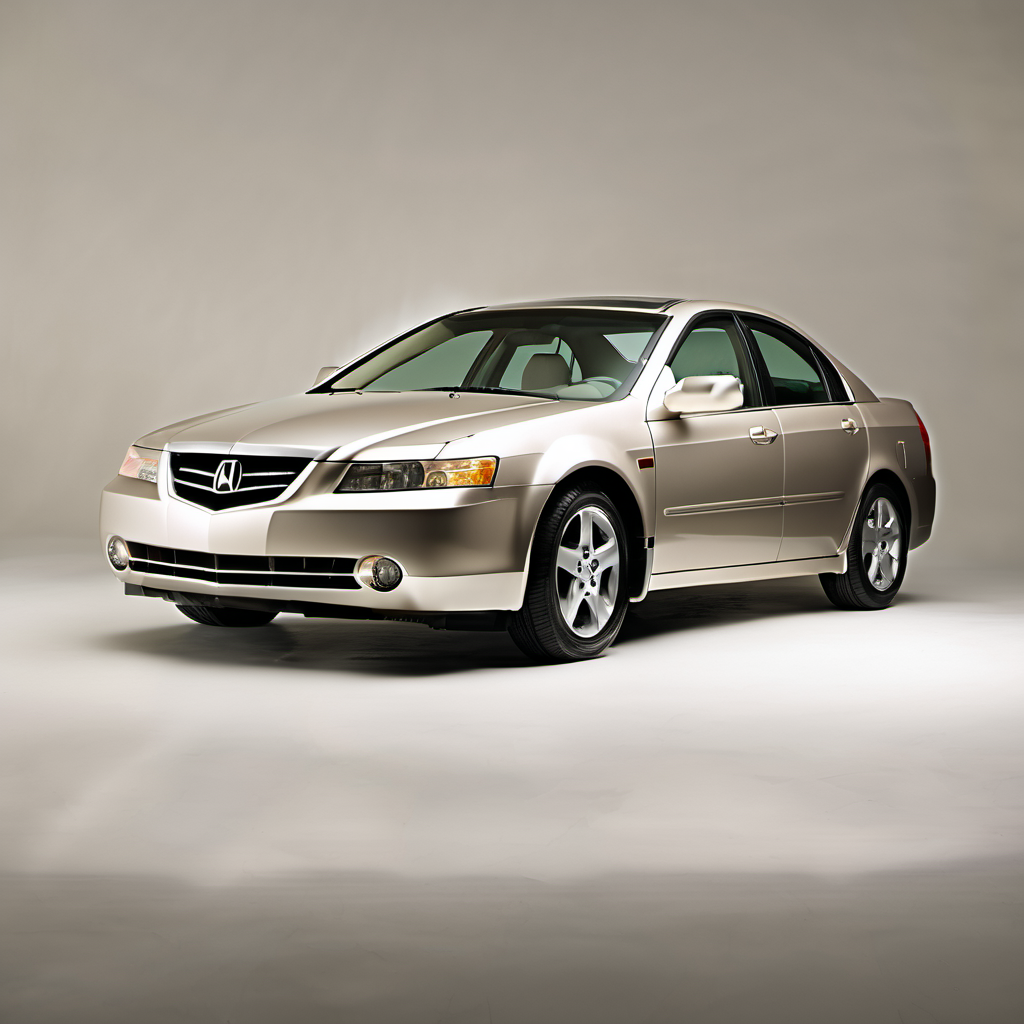
2004 Acura TL Sedan

2004 Acura

TLSedan

Sedan

The 2004 Acura TL is the third-generation version of Honda's luxury sport sedan, and it arrived as a significant redesign that quickly became one of Acura's best sellers. It's powered by a 3.2L SOHC V6 producing 258 horsepower, paired with a 5-speed automatic transmission with paddle shifters — a genuine performance touch for its era. The cabin is well-appointed with standard leather, a Bose sound system, and a navigation option, making it a compelling value against European competitors. At its core, the TL is a Honda Accord underneath, which is both a compliment and a caveat. The platform is proven and parts are accessible, but the engine-transmission pairing has a documented weakness: the 5-speed automatic (BAYA/MGFA) is known for premature failure, especially when driven spiritedly or not serviced on a short interval. This is the single biggest ownership risk on this generation. For the price point these trade at today, a well-maintained 2004 TL with a transmission service history is a strong used-car buy. Skip one that can't show transmission service records, or budget accordingly.

Reliability
3/5
Verified data
Specs shown for TL — the most common configuration. Other trims may vary in engine, drivetrain, or fuel economy. Sign in to see your vehicle's exact specs.
Engine
[object Object]
Drivetrain
FWD
Fuel
Premium gasoline
MPG
18 city / 28 hwy / 21 combined
Seats
Doors
Body
Midsize Cars

Overview

AI-curated

The 2004 Acura TL is the third-generation version of Honda's luxury sport sedan, and it arrived as a significant redesign that quickly became one of Acura's best sellers. It's powered by a 3.2L SOHC V6 producing 258 horsepower, paired with a 5-speed automatic transmission with paddle shifters — a genuine performance touch for its era. The cabin is well-appointed with standard leather, a Bose sound system, and a navigation option, making it a compelling value against European competitors. At its core, the TL is a Honda Accord underneath, which is both a compliment and a caveat. The platform is proven and parts are accessible, but the engine-transmission pairing has a documented weakness: the 5-speed automatic (BAYA/MGFA) is known for premature failure, especially when driven spiritedly or not serviced on a short interval. This is the single biggest ownership risk on this generation. For the price point these trade at today, a well-maintained 2004 TL with a transmission service history is a strong used-car buy. Skip one that can't show transmission service records, or budget accordingly.

Known for
  • 258-hp 3.2L V6 — strong pull for a FWD luxury sedan of its era
  • Upscale interior with standard leather, Bose audio, and real wood trim
  • Honda mechanical underpinnings — widely serviceable at independent shops
  • Paddle-shift automatic — a sporty feature uncommon at this price in 2004
Best for
  • Daily commuters who want near-luxury comfort without European repair bills
  • Buyers who prioritize a smooth, refined highway cruiser
  • Owners comfortable doing DIY or using an independent Honda/Acura shop
Watch for
  • 5-speed automatic transmission failure — the generation's Achilles heel
  • Power steering hose leaks on higher-mileage examples
  • Timing belt service — skipped intervals cause catastrophic engine damage
  • Premium fuel requirement adds to ongoing fuel cost

Common issues by mileage

6 known

5-Speed Automatic Transmission Failure

high
Typically appears
80–130k mi
Estimated repair
$2,200 – $4,500

Timing Belt & Water Pump Service (Interference Engine — Critical)

high
Typically appears
90–105k mi (or 7 years)
Estimated repair
$550 – $950

Power Steering Hose Leak

medium
Typically appears
100–160k mi
Estimated repair
$150 – $350

VTC (Variable Timing Control) Actuator Rattle on Cold Start

medium
Typically appears
80–150k mi
Estimated repair
$400 – $900

Oxygen / A-F Sensor Heater Circuit Fault

medium
Typically appears
100–180k mi
Estimated repair
$180 – $420

Valve Timing Control Solenoid (VTEC/VTC Solenoid) Failure

medium
Typically appears
100–170k mi
Estimated repair
$200 – $500

Maintenance schedule

  1. 1
    Every 30,000 miles — do not extend Transmission fluid change (ATF-Z1 or Honda DW-1 only)

    This is the single most important service on this car. The BAYA transmission is heat-sensitive and fluid-critical. Using non-Honda ATF or going long on intervals is a leading cause of the premature failures this generation is known for.

  2. 2
    Every 90,000 miles or 7 years, whichever comes first Timing belt, water pump, and drive belt replacement

    This is an interference engine — a broken timing belt destroys the engine. Always replace the water pump at the same time; the labor is already open. Verify this service was done before purchasing a used example.

  3. 3
    Every 5,000 miles Engine oil and filter change (full synthetic 5W-20)

    The VTC actuator and VTEC system depend on clean oil at proper pressure. Stretching oil changes accelerates sludging and contributes to camshaft timing codes.

  4. 4
    Every 3 years Brake fluid flush

    Honda specifies this interval. Moisture-laden brake fluid lowers boiling point and accelerates internal caliper corrosion — especially relevant with Wisconsin road salt exposure.

  5. 5
    Every 90,000 miles Spark plug replacement (iridium)

    Factory iridium plugs have a long service life, but worn plugs on a high-compression V6 noticeably affect idle quality and fuel economy.

  6. 6
    Every 30,000 miles or annually Power steering fluid check and inspection of hoses

    Hose leaks are common past 100k mi. Catching a weeping hose early is a $200 fix; ignoring it until the rack runs dry is a much more expensive outcome.

  7. 7
    Every 15,000–20,000 miles Cabin and engine air filter replacement

    Wisconsin road dust and cottonwood season clog filters quickly. A dirty engine air filter affects fuel trim on this VTEC engine.

  8. 8
    First change at 10 years / 120k mi, then every 5 years Coolant flush (Honda pre-mix only)

    Honda's long-life coolant degrades slowly but mixing with non-OEM coolant causes silicate precipitation that accelerates water pump wear — especially important to address around timing belt service.

Always defer to the manufacturer's service manual for warranty-mandated intervals.

Cost of ownership

Annual maintenance
$600 – $1,400
Fuel
Premium fuel required (91 octane). At 21 MPG combined and ~15,000 miles/year, expect roughly $2,200–$2,700/year depending on pump prices.
Insurance
Typically moderate — full coverage on a 20-year-old luxury sedan runs roughly $900–$1,400/year in the Lake Geneva area depending on driver profile.

Day-to-day costs are reasonable for a used luxury sedan — Honda parts pricing, not European. The budget wildcard is the transmission: if it hasn't been replaced or rebuilt recently, set aside $2,500–$4,500 as a contingency. Fuel cost is the persistent overhead since premium is non-negotiable on this engine.
Seasonal care

Lake Geneva, WI
Winter
  • Switch to a full synthetic 5W-20 if not already running it — critical for cold-start oil flow to the VTC actuator at sub-zero Wisconsin temps. Cold-start VTC rattle is a known symptom of oil starvation.
  • Test the battery before November. The 3.2L V6 draws significant cranking current; a marginal battery that starts fine in September will leave you stranded at -10°F.
  • Flush washer fluid reservoir and refill with a -30°F or better rated fluid. Lake Geneva winters regularly hit single digits; summer washer fluid freezes solid in the lines.
  • Check antifreeze concentration — should be protected to at least -40°F. Verify with a tester; a 50/50 Honda pre-mix is the safe baseline.
  • Inspect undercarriage for rust annually after winter. FWD subframe and brake lines are salt-exposure targets on any Midwestern vehicle this age.
  • Use rubber-blade winter wipers to handle ice and snow buildup on the windshield through January and February.
Summer
  • Check tire pressure monthly — pressures drop 1 PSI for every 10°F change. A tire properly inflated in April can be 4–6 PSI low by July.
  • Inspect the A/C system operation early in spring. The refrigerant charge and condenser condition are worth checking before the first hot week — recharges are cheap; a failed compressor mid-July is not.
  • Watch coolant temperature on hot days in stop-and-go traffic. A partially clogged radiator or aging coolant temp sensor can mask an overheating condition.
  • Clean pollen and debris from the cabin air filter intake — cottonwood season in southern Wisconsin is hard on filters.

Comparable vehicles

If you're shopping for one

Red flags
  • No transmission fluid change records, especially past 80,000 miles
  • Slipping, shuddering, or delayed engagement in the automatic transmission — walk away
  • No timing belt service documentation past 90k miles or 7+ years of age
  • Active check engine light — pull codes before purchase; P0012, P0015, P0026–P0029 indicate VTC/VTEC issues that can be expensive
  • Heavy undercarriage rust on brake lines or the front subframe
  • Oil leaks visible at the front of the engine near the timing cover — may indicate deferred timing belt service
What to inspect
  • Transmission service records — this is non-negotiable. Ask for receipts showing Honda-spec ATF changes. If records don't exist, have a shop do a transmission fluid inspection (color, smell, particulates) before purchase.
  • Timing belt service record — confirm it was done. Look for a sticker in the engine bay or receipts. If no proof, budget for it immediately.
  • Cold-start VTC actuator rattle — start the car cold and listen for a brief rattling from the front of the engine in the first 3–5 seconds. Persistent rattle after warmup indicates oil starvation or actuator wear.
  • Power steering fluid condition and hose inspection — look under the hood for any oily residue around PS hoses and the rack.
  • Undercarriage rust inspection — pay particular attention to the subframe, brake lines, and fuel lines on any Wisconsin or Midwest car this age.
  • Check all four tires for uneven wear — FWD torque steer and worn suspension bushings show up in tire wear patterns.
AI profile generated 1 day ago · claude-sonnet-4-6 · v2.