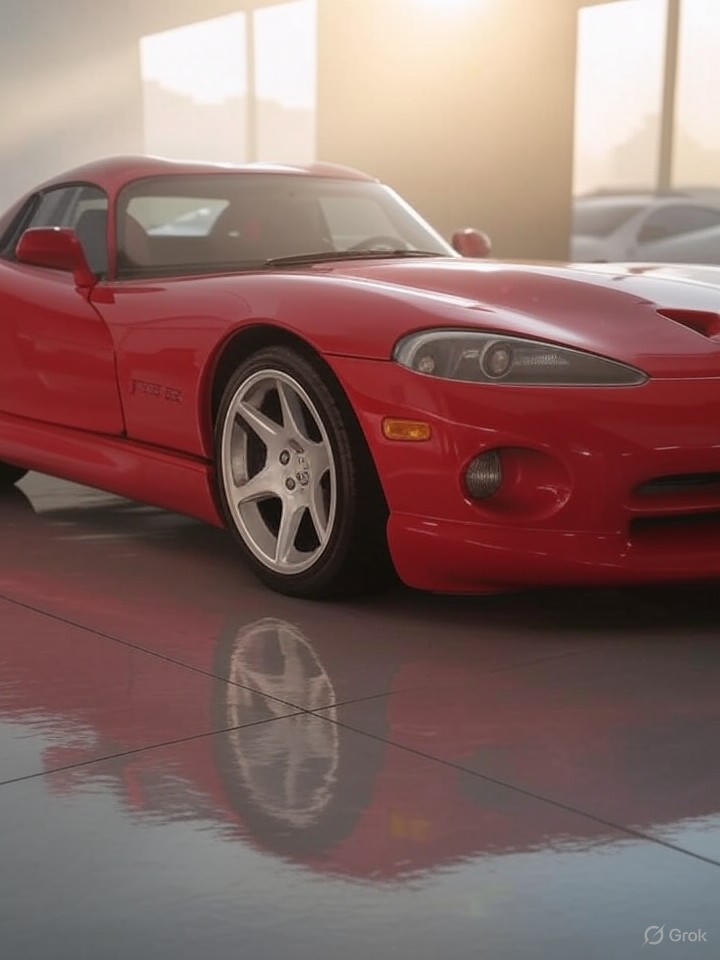
1999 Dodge Viper Coupe

1999 Dodge

ViperCoupe

Coupe

The 1999 Dodge Viper GTS Coupe is an uncompromising American supercar built around a hand-assembled 8.0L V10 engine that produces 450 hp and 490 lb-ft of torque. It is raw, loud, and blindingly fast — the twin-stripe coupe body is iconic, and the driving experience is intentionally analog. Dodge built the Viper to make a statement, not to pamper its driver. The Gen 2 Viper (1996–2002) refined the original roadster concept with a fixed roof, improved aerodynamics, and slightly better interior quality — though 'slightly' is relative. Expect no traction control, no ABS on most trims, no airbags on early cars, and side exhausts hot enough to burn your legs getting in. This is a car you drive, not one that drives itself. Owning a Viper in Wisconsin means carefully managing its seasonal limitations. This is a fair-weather, low-mileage car for most owners. Salt, gravel, and sub-zero starts are genuinely harmful to it, and the side-exit exhaust placement makes winter use a non-starter for practical reasons. Plan on storing it from November through April.

Reliability
3/5
Verified data
Specs shown for Viper Convertible — the most common configuration. Other trims may vary in engine, drivetrain, or fuel economy. Sign in to see your vehicle's exact specs.
Engine
[object Object]
Drivetrain
RWD
Fuel
Premium gasoline
MPG
10 city / 19 hwy / 13 combined
Seats
Doors
Body
Two Seaters

Overview

AI-curated

The 1999 Dodge Viper GTS Coupe is an uncompromising American supercar built around a hand-assembled 8.0L V10 engine that produces 450 hp and 490 lb-ft of torque. It is raw, loud, and blindingly fast — the twin-stripe coupe body is iconic, and the driving experience is intentionally analog. Dodge built the Viper to make a statement, not to pamper its driver. The Gen 2 Viper (1996–2002) refined the original roadster concept with a fixed roof, improved aerodynamics, and slightly better interior quality — though 'slightly' is relative. Expect no traction control, no ABS on most trims, no airbags on early cars, and side exhausts hot enough to burn your legs getting in. This is a car you drive, not one that drives itself. Owning a Viper in Wisconsin means carefully managing its seasonal limitations. This is a fair-weather, low-mileage car for most owners. Salt, gravel, and sub-zero starts are genuinely harmful to it, and the side-exit exhaust placement makes winter use a non-starter for practical reasons. Plan on storing it from November through April.

Known for
  • Massive 8.0L V10 engine — one of the largest production car engines ever
  • Brutal, unassisted driving dynamics — no ABS, no stability control
  • Iconic twin-stripe GTS coupe body with gull-wing doors
  • Side-exit exhaust pipes that run at leg height
  • Extremely low production numbers — every car is collectible
Best for
  • Enthusiasts who want a pure, driver-focused supercar experience
  • Weekend and track-day drivers
  • Collectors looking for appreciating American muscle
  • Owners who have a dedicated warm-weather garage and storage plan
Watch for
  • No ABS or traction control — requires experienced, disciplined driver
  • Side exhaust burns — a genuine danger for passengers unfamiliar with the car
  • V10 consumes premium fuel at a high rate; budget accordingly
  • Parts and specialist labor can be expensive and hard to source
  • Not a daily driver — heat soak, road noise, and hard ride make it impractical

Common issues by mileage

6 known

Coolant leaks from intake manifold gaskets and water pump

high
Typically appears
30–80k mi
Estimated repair
$400 – $1,000

Rubber weatherstripping and door seal deterioration

high
Typically appears
Any age — time-based
Estimated repair
$300 – $800

Side-exit exhaust system rust, cracks, and heat shield damage

high
Typically appears
Any mileage — age and exposure
Estimated repair
$500 – $3,000

Oxygen sensor failure or heater circuit faults

medium
Typically appears
40–100k mi
Estimated repair
$150 – $600

Battery drain and electrical gremlins from long-term storage

high
Typically appears
Any — storage-related
Estimated repair
$100 – $500

Clutch wear — aggressive driving accelerates wear significantly

medium
Typically appears
20–60k mi
Estimated repair
$800 – $2,000

Maintenance schedule

  1. 1
    Every 3,000–5,000 mi or annually, whichever comes first Engine oil and filter change — use a high-zinc (ZDDP) oil appropriate for flat-tappet V10

    The pushrod V10 has flat-tappet lifters that require higher zinc content than modern low-ZDDP oils. Using the wrong oil accelerates camshaft and lifter wear significantly.

  2. 2
    Every 2 years Coolant flush and inspection of hoses and water pump

    The V10 runs hot and the cooling system works hard. Old coolant becomes acidic and attacks aluminum. Hoses and the water pump are common failure points on high-mileage or aged cars.

  3. 3
    Every 2 years Brake fluid flush

    Brake fluid absorbs moisture over time, lowering its boiling point. With a car capable of high-speed stops and occasional track use, degraded brake fluid is a safety issue.

  4. 4
    Every 3–5 years Inspect and replace weatherstripping and door seals

    Rubber degrades with age and UV exposure. Failed seals let water into the footwells and can damage the fiberglass body panels. Especially important in Wisconsin's freeze-thaw cycles.

  5. 5
    Every 5–6 years regardless of tread depth Tire inspection and replacement — check age code (DOT date)

    Performance tires on low-mileage cars often age out before they wear out. Old rubber loses grip and can fail suddenly at speed. Check the four-digit DOT date on the sidewall.

  6. 6
    Every winter storage season Battery maintenance or trickle charge during storage

    Low usage kills batteries. A quality battery tender (not just any charger) during Wisconsin's 5-month storage season prevents discharge damage and extends battery life.

  7. 7
    Annually Exhaust system inspection — pipes, flanges, heat shields

    Side-exit exhausts are exposed to road debris and moisture from below. Cracks or failed heat shields are both a fire risk and a burn hazard to occupants.

  8. 8
    Every 20,000 mi or if slippage/hard engagement is noticed Clutch inspection and adjustment

    The Viper's torque is enormous and clutch wear accelerates with spirited driving. Catching a worn clutch early prevents flywheel damage.

Always defer to the manufacturer's service manual for warranty-mandated intervals.

Cost of ownership

Annual maintenance
$800 – $3,000
Fuel
Premium fuel only. At 13 MPG combined and typical Wisconsin driving, budget $2,000–$4,000/year in fuel costs depending on miles driven. Low-mileage seasonal use will be on the lower end.
Insurance
Expect $1,200–$3,500/year for a 25-year-old collectible supercar. Agreed-value collector car insurance is strongly recommended over standard auto policies — it protects the car's actual market value, not depreciated book value.

Annual maintenance costs are moderate when the car is healthy — it's mechanically simple. The real costs come from deferred maintenance on stored cars (dried seals, aged fluids, corroded connectors) and any performance or exhaust work, which gets expensive fast given specialty parts and limited technician availability. Budget a larger repair fund than you would for a daily driver.
Seasonal care

Lake Geneva, WI
Winter
  • Do not drive on salted roads — salt will aggressively attack the undercarriage, exhaust, and aluminum components. Store the car by mid-November.
  • Use a quality battery tender throughout storage to prevent discharge. Wisconsin winters are long — a dead or sulfated battery is a common spring surprise.
  • Change oil before storage, not after — used oil contains acids and combustion byproducts that sit against metal surfaces all winter.
  • Inflate tires to the upper end of spec before storage and place on tire cradles or move the car monthly to prevent flat spots on performance tires.
  • Use a breathable indoor car cover — a non-breathable cover traps moisture and promotes rust and mold, especially in an unheated garage.
  • Add a fuel stabilizer if the car will sit more than 60 days. The V10's large fuel system can develop varnish deposits in ethanol-blended pump fuel.
Summer
  • Check tire pressure frequently — summer heat causes pressure to rise, and over-inflated performance tires reduce grip. Check cold, before driving.
  • Monitor coolant temperature closely, especially in stop-and-go traffic. The Viper's cooling system is sized for moving air, not idling in traffic.
  • Inspect the A/C system before the season — the cabin heats up extremely fast given the low roofline and large glass area. R-134a systems on 25-year-old cars commonly need a recharge.
  • Check brake pads before any track or spirited driving — summer heat amplifies brake fade on worn pads.

Comparable vehicles

If you're shopping for one

Red flags
  • No service records — on a specialty car like this, an undocumented history almost always means something was neglected
  • Evidence of track use without corresponding brake/clutch/tire servicing
  • Mismatched paint or fiberglass repairs — Viper body panels are expensive and repairs are hard to hide well
  • Visible rust or heavy corrosion on exhaust, undercarriage, or suspension — suggests winter driving or flood exposure
  • Any sign of coolant in the oil (milky dipstick) — indicates head gasket or intake gasket failure
  • Modified ECU or aftermarket fuel management without documentation — the factory tune is carefully matched to this engine
What to inspect
  • Compression test all 10 cylinders — uneven readings indicate valve or ring wear from aggressive driving or poor oil maintenance
  • Check the entire exhaust system underneath for rust, cracks, and missing heat shields — replacements are expensive
  • Inspect footwell and carpet for water intrusion from failed door seals
  • Look at tire sidewall DOT dates — performance tires age out in 6 years regardless of tread
  • Verify the clutch engages cleanly with no slipping or shuddering under load
  • Check all rubber hoses in the cooling system for cracking, softness, or bulging — a 25-year-old car needs fresh hoses
  • Ask for records of oil type used — wrong (low-ZDDP) oil over years causes camshaft damage that won't show until it's expensive
AI profile generated 11 days ago · claude-sonnet-4-6 · v2.