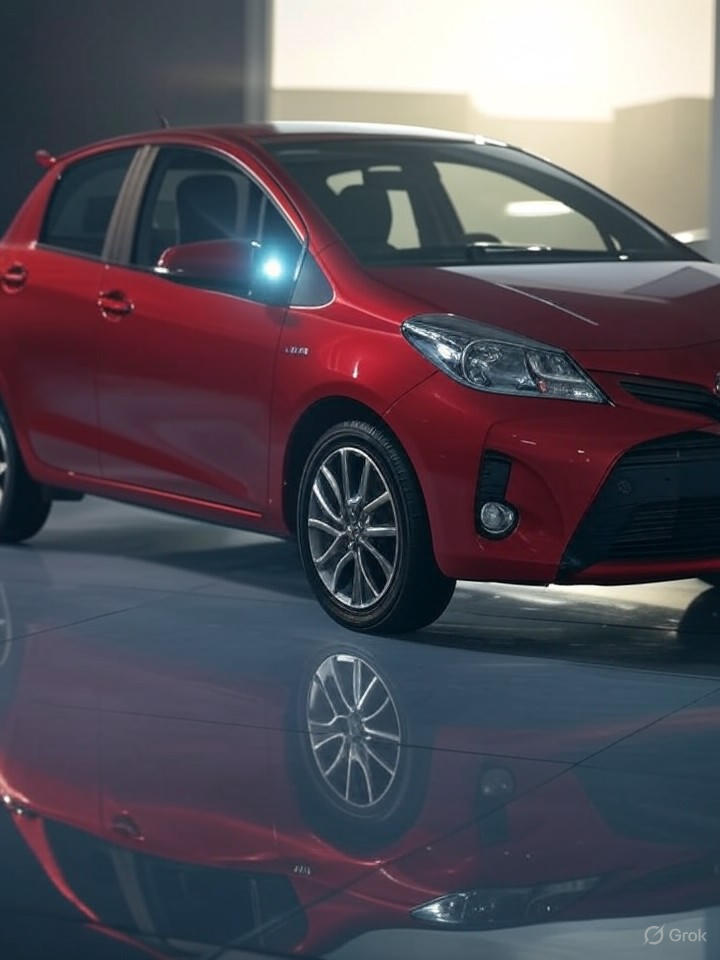
2012 Toyota Yaris Hatchback

2012 Toyota

YarisHatchback

Hatchback

The 2012 Toyota Yaris Hatchback is a subcompact city car built around simplicity, fuel economy, and low running costs. Powered by a 1.5L four-cylinder and available in 3-door and 5-door hatchback body styles, it was aimed squarely at first-time buyers, commuters, and anyone who wanted a no-fuss, easy-to-park daily driver. Toyota kept the Yaris mechanically straightforward — no turbos, no dual-clutch gearbox complexity, no elaborate driver aids. That philosophy pays off in long-term ownership: repairs are affordable, parts are plentiful, and most independent shops can handle everything the car needs. The 1NZ-FE engine in this generation has a strong track record when oil changes are kept current. The trade-offs are equally clear: the interior is basic, rear-seat space is tight for adults, the automatic transmission is a conventional 4-speed which feels dated compared to the competition, and the 1.5L makes modest power — freeway merges require planning. But for Lake Geneva-area commuting and errand running, it checks the right boxes.

Reliability
4/5
Verified data
Specs shown for Yaris — the most common configuration. Other trims may vary in engine, drivetrain, or fuel economy. Sign in to see your vehicle's exact specs.
Engine
[object Object]
Drivetrain
FWD
Fuel
Gasoline
MPG
29 city / 34 hwy / 31 combined
Seats
Doors
Body
Compact Cars

Overview

AI-curated

The 2012 Toyota Yaris Hatchback is a subcompact city car built around simplicity, fuel economy, and low running costs. Powered by a 1.5L four-cylinder and available in 3-door and 5-door hatchback body styles, it was aimed squarely at first-time buyers, commuters, and anyone who wanted a no-fuss, easy-to-park daily driver. Toyota kept the Yaris mechanically straightforward — no turbos, no dual-clutch gearbox complexity, no elaborate driver aids. That philosophy pays off in long-term ownership: repairs are affordable, parts are plentiful, and most independent shops can handle everything the car needs. The 1NZ-FE engine in this generation has a strong track record when oil changes are kept current. The trade-offs are equally clear: the interior is basic, rear-seat space is tight for adults, the automatic transmission is a conventional 4-speed which feels dated compared to the competition, and the 1.5L makes modest power — freeway merges require planning. But for Lake Geneva-area commuting and errand running, it checks the right boxes.

Known for
  • Exceptional fuel economy for its era
  • Low cost of ownership and easy DIY maintenance
  • Reliable 1NZ-FE engine with long service life
  • Tight turning radius and easy city parking
  • Minimal electronics complexity
Best for
  • City and suburban commuters
  • First-time or budget-conscious car owners
  • Low-mileage drivers who prioritize economy over performance
  • Those who want an easy-to-maintain second car
Watch for
  • Dated 4-speed automatic struggles on highway on-ramps
  • Very basic interior — no soft-touch surfaces, minimal sound deadening
  • Limited cargo space and tight rear legroom
  • Small fuel tank means more frequent fill-ups on longer trips
  • Road noise at highway speeds is noticeable

Common issues by mileage

6 known

Oxygen sensor heater circuit failure

medium
Typically appears
80–130k mi
Estimated repair
$150 – $300

Upstream O2 sensor heater control circuit fault

medium
Typically appears
80–140k mi
Estimated repair
$120 – $280

Camshaft position timing over-retarded (VVT-i oil flow issue)

low
Typically appears
100–160k mi
Estimated repair
$200 – $600

Rust and underbody corrosion — rocker panels, subframe, brake lines

high
Typically appears
60k mi+ (age-driven in Wisconsin)
Estimated repair
$300 – $2,000

Worn front struts and strut mounts

medium
Typically appears
80–120k mi
Estimated repair
$350 – $700

Battery failure in cold weather

high
Typically appears
40k mi+ (age/climate-driven)
Estimated repair
$120 – $200

Maintenance schedule

  1. 1
    Every 5,000 mi or 6 months Engine oil and filter change

    The 1NZ-FE's VVT-i system relies on clean oil pressure to actuate the cam phaser. Neglecting oil changes is the leading cause of VVT-related codes and long-term sludge buildup on this engine.

  2. 2
    Every 30,000 mi Automatic transmission fluid change

    Toyota says 'lifetime fluid' but the 4-speed in this Yaris shifts better and lasts longer with fresh fluid. Dark or burnt-smelling ATF at this age is a red flag.

  3. 3
    Every 60,000 mi (iridium plugs) Spark plug replacement

    OEM iridium plugs are long-lived but worn plugs in a small 4-cylinder show up immediately as rough idle and reduced fuel economy.

  4. 4
    Every 30,000 mi or annually Air filter replacement

    Small engine, small filter — a clogged air filter has an outsized effect on MPG and throttle response in the Yaris.

  5. 5
    Every 2 years Brake fluid flush

    Brake fluid is hygroscopic and absorbs moisture over time, lowering its boiling point. Wisconsin winters accelerate corrosion in the brake system when fluid moisture is high.

  6. 6
    Every 20,000 mi or with each brake service Inspect and lubricate brake caliper slides

    Frozen caliper slides from road salt cause uneven pad wear and premature rotor damage — very common on small FWD cars in the upper Midwest.

  7. 7
    Every 50,000 mi or 5 years Coolant flush

    Degraded coolant loses freeze-point protection. For Lake Geneva winters, maintaining the correct coolant concentration is essential.

  8. 8
    Every 30,000 mi or annually Inspect CV axle boots

    FWD cars eat CV boots. Salt exposure accelerates rubber cracking. A torn boot caught early is a $100–$200 fix; a failed CV joint is $300–$500.

Always defer to the manufacturer's service manual for warranty-mandated intervals.

Cost of ownership

Annual maintenance
$400 – $850
Fuel
At 31 MPG combined and ~12,000 mi/year, expect roughly $1,200–$1,500/year at typical Midwest gas prices. One of the cheapest non-hybrid cars to fuel.
Insurance
Among the lowest insurance costs in its class — low replacement value, low horsepower, and good safety ratings keep premiums modest. Expect $800–$1,300/year for full coverage depending on driver profile.

The Yaris is one of the least expensive cars to own and operate. Parts are cheap, labor time is short (small engine bay, simple systems), and fuel costs are minimal. The main wildcard on a Wisconsin example this age is rust — catching and treating underbody corrosion early is far cheaper than dealing with it later.
Seasonal care

Lake Geneva, WI
Winter
  • Test the battery before first hard freeze — cold cranking amps drop significantly below 20°F and this car's small engine offers little help to a weak battery.
  • Switch to a full-synthetic 0W-20 or 5W-30 oil before winter for better cold-start lubrication and faster VVT-i oil pressure buildup.
  • Inspect brake lines and fuel lines for corrosion — the Yaris sits low and road salt reaches everything underneath.
  • Use winter-rated washer fluid rated to at least -20°F; the standard reservoir is small and runs out quickly when roads are heavily salted.
  • Swap to dedicated winter tires — the Yaris's light weight and FWD make it surprisingly capable in snow with proper tires, but the OEM all-seasons are marginal.
  • After each significant snowfall, rinse the undercarriage when temps allow to slow salt corrosion on the subframe and rocker panels.
Summer
  • Check tire pressure monthly — small tires on a light car are sensitive to pressure changes; even 3–4 PSI low noticeably affects handling and fuel economy.
  • Inspect the cabin air filter — a clogged filter forces the A/C blower harder and reduces cooling efficiency on hot days.
  • Verify A/C system charge and inspect the condenser for road debris — the Yaris condenser is small and loses capacity quickly when partially blocked.
  • Check coolant concentration with a tester to confirm adequate heat-protection range alongside freeze protection.

Comparable vehicles

If you're shopping for one

Red flags
  • Any visible rust bubbling through rocker panel paint or surface rust on the subframe — indicates likely deeper corrosion.
  • Transmission that slips, hunts for gears, or shudders — the 4-speed is durable but not rebuildable cheaply; a bad one means a used unit swap.
  • Oil that looks or smells burnt, or evidence of frequent top-offs between changes (potential ring wear or valve stem seals).
  • Mismatched tires or heavily worn fronts only — suggests the previous owner ignored rotation, possibly indicating other deferred maintenance.
  • Check engine light present or evidence of a recently cleared code — ask for a scan tool readout before purchase.
What to inspect
  • Full underbody inspection for rust on rocker panels, subframe, brake lines, and fuel lines — this is the single biggest risk on a Wisconsin-market Yaris of this age.
  • Check all four CV axle boots for cracks or grease slinging; listen for clicking on full-lock turns.
  • Verify oil change history — pull the dipstick and look for dark, sludgy oil or a milky appearance (head gasket concern).
  • Test the A/C for cold output; the compressor and condenser are inexpensive to replace but a non-functional A/C should be factored into price.
  • Drive at highway speeds and listen for wheel bearing hum — a common wear item by 100k mi on small FWD cars.
  • Check that the VVT-i system isn't throwing codes (P0012) — this usually points to neglected oil changes and can lead to expensive cam phaser repairs.
AI profile generated 4 days ago · claude-sonnet-4-6 · v2.