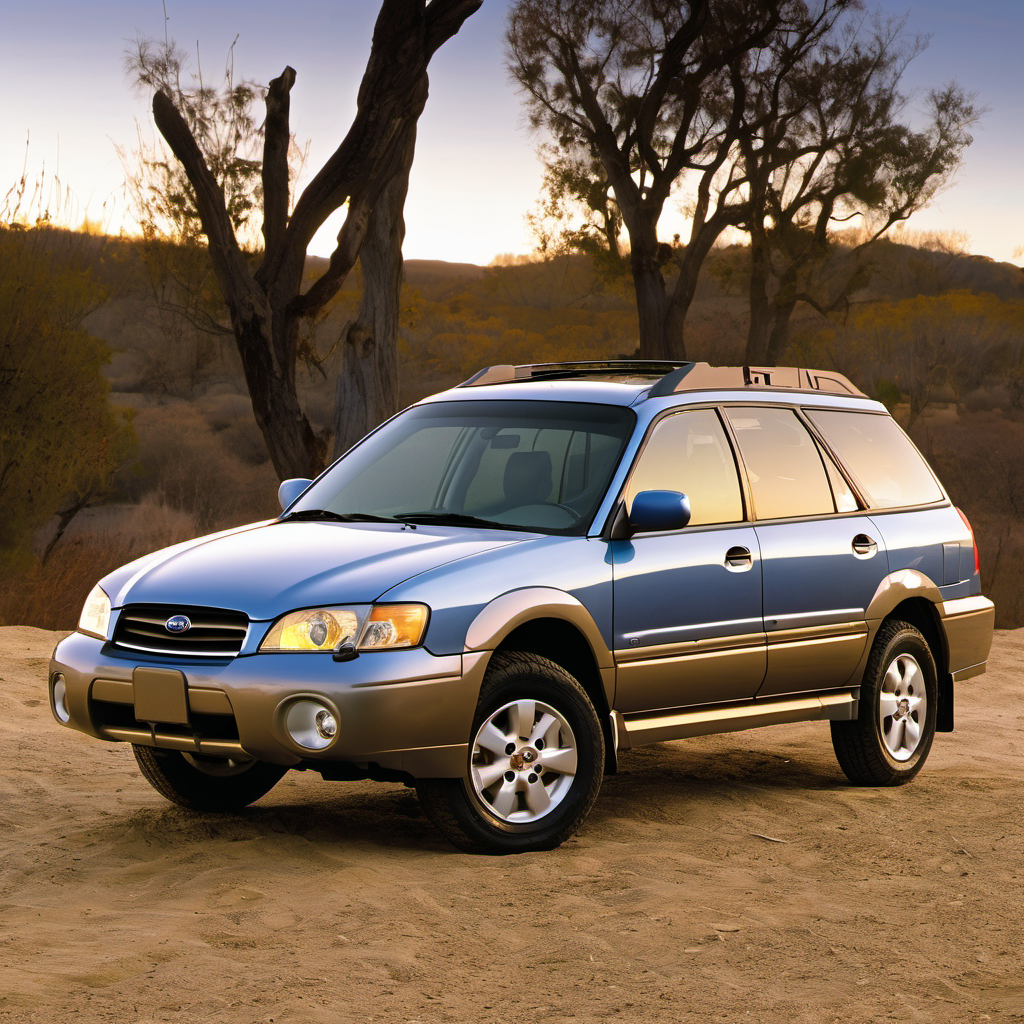
2000 Subaru Outback Wagon

2000 Subaru

OutbackWagon

2.5L H4 SOHC · Wagon

The 2000 Subaru Outback Wagon is a second-generation (1995–1999 platform, carried into 2000 with updates) all-wheel-drive lifted wagon that carved out a loyal following in the upper Midwest and Mountain West. Built on the Legacy platform with added ride height, skid plates, and body cladding, it bridges the gap between a practical family wagon and a mild off-road capable crossover — before 'crossover' was even a common word. Under the hood the standard engine is a 2.5L SOHC flat-four, though a 2.2L four was also offered briefly. The symmetrical AWD system is full-time and requires zero input from the driver — a genuine advantage on Wisconsin's icy and snow-packed roads. The low center of gravity from the horizontally-opposed (boxer) engine layout gives it better handling than most taller SUVs of the same era. At 24 years old, any surviving 2000 Outback is a high-mileage or carefully preserved example. Head gasket failure on the 2.5L SOHC engine is the defining concern — it's not a question of 'if' at this age, it's a question of 'has it been done.' Buy accordingly, and a well-maintained example can still deliver reliable, affordable transportation with standout winter capability.

Reliability
3/5
Verified data
Engine
2.5L H4 SOHC
Drivetrain
AWD
Fuel
Gasoline
MPG
19 city / 26 hwy / 22 combined
Seats
5
Doors
4
Body
Wagon
MSRP
$24,995

Overview

AI-curated

The 2000 Subaru Outback Wagon is a second-generation (1995–1999 platform, carried into 2000 with updates) all-wheel-drive lifted wagon that carved out a loyal following in the upper Midwest and Mountain West. Built on the Legacy platform with added ride height, skid plates, and body cladding, it bridges the gap between a practical family wagon and a mild off-road capable crossover — before 'crossover' was even a common word. Under the hood the standard engine is a 2.5L SOHC flat-four, though a 2.2L four was also offered briefly. The symmetrical AWD system is full-time and requires zero input from the driver — a genuine advantage on Wisconsin's icy and snow-packed roads. The low center of gravity from the horizontally-opposed (boxer) engine layout gives it better handling than most taller SUVs of the same era. At 24 years old, any surviving 2000 Outback is a high-mileage or carefully preserved example. Head gasket failure on the 2.5L SOHC engine is the defining concern — it's not a question of 'if' at this age, it's a question of 'has it been done.' Buy accordingly, and a well-maintained example can still deliver reliable, affordable transportation with standout winter capability.

Known for
  • Full-time symmetrical AWD that excels in snow and ice
  • Boxer engine's low center of gravity and distinctive sound
  • Practical lifted-wagon format with car-like handling
  • Devoted owner community with strong DIY support
  • One of the earliest vehicles to define the crossover/AWD wagon segment
Best for
  • Wisconsin winters — AWD, ground clearance, and confident handling on slippery roads
  • Outdoor enthusiasts who need gear space and mild trail access
  • Budget-minded buyers who want AWD without SUV fuel costs
  • DIY-capable owners comfortable with routine boxer engine maintenance
Watch for
  • Head gasket failure on the 2.5L SOHC — nearly universal by 150k mi if not already replaced
  • Rust on frame rails, subframe, and rocker panels from road salt exposure
  • Automatic transmission fluid neglect leading to early trans wear
  • Timing belt interval — must be replaced on schedule or engine is at serious risk
  • Worn or mismatched tires destroying the AWD center differential

Common issues by mileage

6 known

Head Gasket Failure (2.5L SOHC)

high
Typically appears
100–150k mi
Estimated repair
$1,200 – $2,200

Timing Belt & Water Pump Service (interference engine)

high
Typically appears
60–105k mi (every 60k thereafter)
Estimated repair
$500 – $900

Rust — Frame Rails, Subframe, Rockers

high
Typically appears
Any mileage on salt-road vehicles
Estimated repair
$500 – $3,000

Automatic Transmission Wear from Fluid Neglect

medium
Typically appears
120–180k mi
Estimated repair
$1,800 – $3,500

Rear Wheel Bearing Failure

medium
Typically appears
100–160k mi
Estimated repair
$250 – $500

Maintenance schedule

  1. 1
    Every 60,000 miles or 5 years — whichever comes first Timing Belt, Water Pump, and Idler/Tensioner Replacement

    This is an interference engine. A snapped belt destroys the engine with no warning. The water pump is driven by the belt — replace it at the same time. At 24 years old, assume it's due unless you have a receipt.

  2. 2
    Every oil change — check for milky oil, sweet exhaust smell, or bubbles in coolant reservoir Coolant System Inspection for Head Gasket Seepage

    The 2.5L SOHC head gaskets are a known weak point. Catching early external seepage saves you from a full coolant-into-oil failure that can ruin the engine.

  3. 3
    Every 30,000 miles using Subaru-spec fluid Automatic Transmission Fluid Change

    Subaru ATFs are specific — using the wrong fluid or skipping intervals accelerates clutch pack wear. At this vehicle's age, do not flush if fluid is very dark; a drain-and-fill is safer.

  4. 4
    Every tire change — verify all four tires match in brand, model, and tread depth within 2/32" AWD System — Tire Matching

    The full-time AWD center differential is easily damaged by mismatched tire circumferences. Even one spare tire used temporarily can cause wear. Budget for four tires at a time.

  5. 5
    Every 30,000 miles Differential and Transfer Case Fluid Change

    Often forgotten, these fluids degrade and the differentials run dry on neglected examples. Inexpensive insurance against a very expensive repair.

  6. 6
    Every fall before winter season Underbody Rust Inspection and Treatment

    Lake Geneva road salt is brutal. Check frame rails, subframe mounts, fuel and brake lines, and rocker seams. Treat bare metal with rust inhibitor each fall — it's cheap compared to structural rust repair.

  7. 7
    Every 30,000 miles Spark Plugs

    Boxer engines require removing the intake manifold on some cylinders — labor adds up. Stay on schedule to avoid misfires that can mask head gasket symptoms.

  8. 8
    Every 2 years regardless of mileage Brake Fluid Flush

    Brake fluid absorbs moisture over time, lowering boiling point. Critical for a Wisconsin vehicle that sees hard braking on icy descents and temperature swings.

Always defer to the manufacturer's service manual for warranty-mandated intervals.

Cost of ownership

Annual maintenance
$800 – $1,800
Fuel
At ~22 MPG combined and Wisconsin average fuel prices, expect roughly $1,500–$2,000/year at 12,000 miles annually.
Insurance
Typically $900–$1,400/year for full coverage in the Lake Geneva area, depending on driver profile. Liability-only on a high-mileage example could be $500–$700.

A well-maintained 2000 Outback is inexpensive to own day-to-day — parts are affordable and independent shops know these cars well. The wildcard is deferred maintenance: a neglected head gasket repair, timing belt failure, or significant rust remediation can each cost more than the car's market value in a single visit. Budget a larger emergency fund if maintenance history is unknown.
Seasonal care

Lake Geneva, WI
Winter
  • Install four matching winter tires — the AWD system works best when all four tires grip equally; all-seasons are a compromise on Lake Geneva's packed snow and black ice.
  • Check battery health every October — cold cranking amps drop sharply below 0°F and the 2.5L boxer needs a strong battery to start reliably in sub-zero temps.
  • Switch to a 0W-30 or 5W-30 full synthetic if using conventional oil — thinner cold-start viscosity protects the engine during the critical first seconds of a cold start.
  • Top off washer fluid with a rated -20°F or lower formula — Lake Geneva winters regularly hit those temps and standard summer fluid will freeze solid in the reservoir or on the windshield.
  • Inspect and treat all underbody surfaces, brake lines, and fuel lines for rust before first heavy salt application — this car's age makes it especially vulnerable.
  • Keep the gas tank at least half full in winter — reduces condensation in the tank and ensures you have fuel weight over the rear axle for traction.
Summer
  • Check tire pressure monthly — pressure drops roughly 1 PSI for every 10°F change; summer heat causes overinflation after a long drive.
  • Inspect the A/C system for refrigerant leaks and compressor clutch engagement — the Outback's A/C is adequate but aging seals on a 24-year-old system commonly develop slow leaks.
  • Check coolant concentration and condition — the head gasket risk makes cooling system health critical; make sure the 50/50 mix is correct and the reservoir is clean with no oily residue.
  • Inspect drive belts (serpentine) for cracking — heat accelerates rubber degradation; a belt failure on a hot day in traffic is avoidable with a visual check.
  • Check heat soak on restart — older fuel injector seals can weep slightly when hot; a rough hot-restart is worth diagnosing before it worsens.

Comparable vehicles

If you're shopping for one

Red flags
  • Milky oil or oily coolant — head gaskets are already failing internally, walk away unless the price reflects a full repair
  • Heavy undercarriage rust at frame rails or subframe — structural rust on a 24-year-old Wisconsin car can make it uneconomical to repair
  • No timing belt service records and over 60k miles since last known change — the engine is living on borrowed time
  • Mismatched tires — potential center differential damage that won't show up on a short test drive but will fail within months
  • Slipping or delayed automatic transmission engagement — at this age, a rebuild or replacement is likely the only fix
  • Seller can't explain why the check engine light is off — at this age, cleared codes are a common concealment tactic
What to inspect
  • Pull the oil dipstick and radiator cap — look for milky or foamy residue indicating coolant mixing with oil (head gasket failure)
  • Check the coolant reservoir for oily film or dark discoloration — another early head gasket warning sign
  • Ask for receipts for timing belt, water pump, and head gasket service — these are the three non-negotiable items on any 2000 Outback
  • Crawl under the car and inspect frame rails, subframe mounting points, and rocker panels for structural rust — not just surface rust
  • Verify all four tires match in brand, model, and tread depth — mismatched tires signal potential AWD differential damage
  • Check brake and fuel lines along the underside for rust perforation — replacing these on a heavily rusted car can be expensive
  • Test drive cold — listen for lifter tick, rough idle, or white exhaust smoke that clears once warm (coolant burn-off)
AI profile generated 4 days ago · claude-sonnet-4-6 · v2.