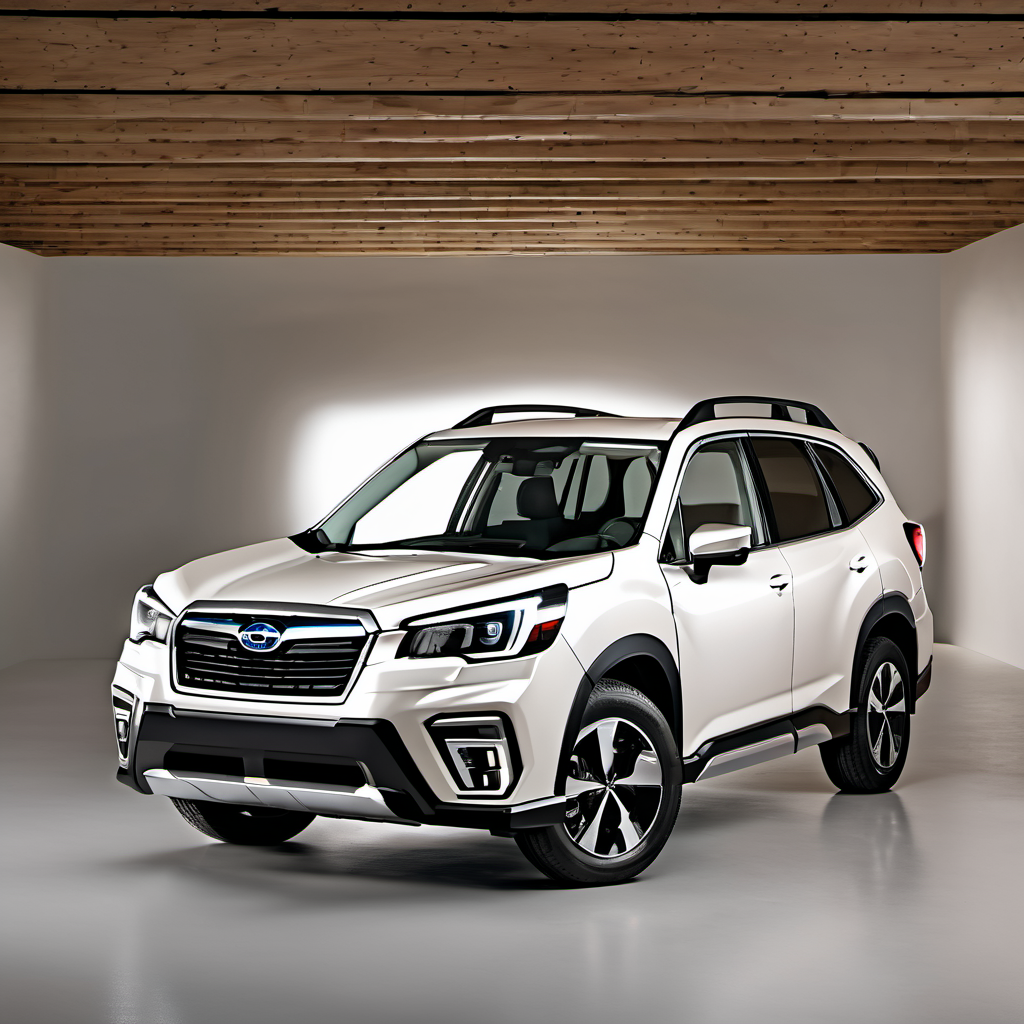
2025 Subaru Forester
Popular pick

2025 Subaru

Forester

2.5L 4-cyl

The 2025 Subaru Forester is a compact SUV built around Subaru's Global Platform, pairing a naturally aspirated 2.5L Boxer four-cylinder with standard symmetrical all-wheel drive and a CVT. It's one of the most practical choices in its class for buyers who need real AWD traction year-round without stepping into a truck-based platform. The cabin prioritizes visibility and utility over style, with a high roofline, large windows, and one of the best driver sightlines in the segment. For Lake Geneva area drivers, the Forester is a natural fit — Subaru's AWD system is always-on (not just activated in slip), which makes a meaningful difference on icy Wisconsin roads compared to optional or part-time systems. Ground clearance is generous enough to handle unplowed driveways without issue. The 2025 model carries over the fifth-generation body with incremental updates to EyeSight driver assist technology. Fuel economy is respectable for an AWD vehicle in this class. The main complaints from owners center on the CVT's rubber-band feel under hard acceleration and an infotainment system that lags behind the competition in responsiveness.

Reliability
4/5
Verified data
Specs shown for Forester AWD — the most common configuration. Other trims may vary in engine, drivetrain, or fuel economy. Sign in to see your vehicle's exact specs.
Engine
[object Object]
Drivetrain
AWD
Fuel
Gasoline
MPG
26 city / 33 hwy / 29 combined
Seats
Doors
Body
Small Sport Utility Vehicle 4WD

Overview

AI-curated

The 2025 Subaru Forester is a compact SUV built around Subaru's Global Platform, pairing a naturally aspirated 2.5L Boxer four-cylinder with standard symmetrical all-wheel drive and a CVT. It's one of the most practical choices in its class for buyers who need real AWD traction year-round without stepping into a truck-based platform. The cabin prioritizes visibility and utility over style, with a high roofline, large windows, and one of the best driver sightlines in the segment. For Lake Geneva area drivers, the Forester is a natural fit — Subaru's AWD system is always-on (not just activated in slip), which makes a meaningful difference on icy Wisconsin roads compared to optional or part-time systems. Ground clearance is generous enough to handle unplowed driveways without issue. The 2025 model carries over the fifth-generation body with incremental updates to EyeSight driver assist technology. Fuel economy is respectable for an AWD vehicle in this class. The main complaints from owners center on the CVT's rubber-band feel under hard acceleration and an infotainment system that lags behind the competition in responsiveness.

Known for
  • Standard symmetrical AWD on every trim
  • Excellent outward visibility and driver ergonomics
  • Generous ground clearance for a non-truck SUV
  • EyeSight driver-assist suite standard across the lineup
  • Roomy, practical interior for its footprint
Best for
  • Wisconsin and upper Midwest year-round drivers
  • Outdoor enthusiasts needing light trail and snow capability
  • Families wanting safety tech without a large SUV
  • High-mileage commuters who want reliable AWD MPG
Watch for
  • CVT can feel sluggish under hard acceleration — not a performance vehicle
  • Infotainment system responsiveness lags some competitors
  • Oil consumption has been reported on this generation's 2.5L; check the dipstick regularly
  • Boxer engine requires full-synthetic 0W-20 — don't skip or substitute
  • Resale is strong, meaning used prices are higher than class average

Common issues by mileage

6 known

Infotainment System Freezes / Slow Response

medium
Typically appears
0–40k mi
Estimated repair
$0 – $350

Engine Oil Consumption

medium
Typically appears
40k–80k mi
Estimated repair
$50 – $500

CVT Shudder or Hesitation

low
Typically appears
60k–120k mi
Estimated repair
$150 – $3,500

Lost Communication with Instrument Panel Cluster (U0155 / network bus faults)

low
Typically appears
10k–40k mi
Estimated repair
$150 – $400

Battery Drain in Cold Weather

medium
Typically appears
0–60k mi
Estimated repair
$150 – $350

Maintenance schedule

  1. 1
    Every 5,000 miles or 6 months Engine Oil & Filter Change (0W-20 Full Synthetic)

    Subaru's Boxer layout can consume oil between changes, especially as miles accumulate. Sticking to 5k intervals and checking the dipstick monthly lets you catch consumption early before it becomes an engine problem.

  2. 2
    Every 30,000 miles under normal use; every 25,000 if used in cold climates or stop-and-go CVT Fluid Service

    Subaru marks CVT fluid 'lifetime' in the owner's manual, but independent shops see CVT failures after 100k on units where the fluid was never changed. In Wisconsin's temperature swings, fresh fluid is cheap insurance.

  3. 3
    Every 7,500 miles or 9 months Tire Rotation

    AWD systems are sensitive to uneven tire wear. Significant diameter differences between axles can stress the center differential. Even tire wear also maximizes traction on snow and ice.

  4. 4
    Every 30,000 miles or 24 months Engine Air Filter

    Wisconsin road dust and pollen are manageable, but if you frequent gravel roads or farm areas, inspect annually. A clogged filter increases fuel consumption and can affect MAF sensor accuracy.

  5. 5
    Every 30,000 miles or 3 years Brake Fluid Flush

    Subaru recommends this interval. Brake fluid absorbs moisture over time, lowering its boiling point. Important on a car that uses hill-hold and EyeSight-integrated braking regularly.

  6. 6
    Every 60,000 miles Spark Plugs (Iridium)

    The 2.5L Boxer uses iridium plugs with a 60k service life. Worn plugs on this engine can trigger misfires that are sometimes misdiagnosed as oil consumption or VVT faults.

  7. 7
    Every 60,000 miles or 5 years (first); every 30,000 miles thereafter Coolant System Inspection & Flush

    Subaru's aluminum Boxer heads are sensitive to coolant degradation. Earlier Subaru generations had head gasket issues tied to coolant neglect — stay ahead of it on this engine too.

  8. 8
    Every 15,000 miles or 12 months Cabin Air Filter

    Wisconsin road salt spray and pollen load cabin filters faster than mild climates. A plugged cabin filter reduces HVAC effectiveness and defroster performance — both matter in winter.

Always defer to the manufacturer's service manual for warranty-mandated intervals.

Cost of ownership

Annual maintenance
$500 – $900
Fuel
At 29 MPG combined and roughly 12,000 miles/year, expect around $1,500–$1,800/year at current upper Midwest gas prices. Premium fuel is not required.
Insurance
Typically $1,200–$1,600/year in the Lake Geneva area for a driver with a clean record, reflecting the Forester's strong safety ratings and moderate repair costs.

The Forester sits in the affordable-to-own tier of compact SUVs. Routine maintenance is straightforward and parts are widely available at independent shops. The main cost wildcard is CVT repair if fluid service is neglected — a CVT replacement can run $3,500–$5,000 at an independent shop. Stay on top of oil level checks and CVT fluid changes and this vehicle has very low surprise-cost potential.

Seasonal care

Lake Geneva, WI
Winter
  • Test the battery before November — cold cranking amps drop sharply below 0°F and the Forester's electronics draw more current than older vehicles. Replace any battery older than 4 years proactively.
  • Switch to a dedicated winter/snow tire set for sustained temperatures below 40°F. Subaru's AWD helps you go, but all-season tires still limit how well you stop and turn on ice.
  • Check wiper blade condition and fill the washer reservoir with -20°F or colder rated fluid. Lake Geneva lake-effect conditions burn through washer fluid fast.
  • Rinse the undercarriage, wheel wells, and frame rails every 2–3 weeks during salt season. Subaru's AWD components and CV axles are exposed to heavy spray.
  • Keep fuel tank at least half full in sub-zero weather to reduce condensation in the fuel system and ensure you have reserve heat if stranded.
  • Allow the engine to idle 30–60 seconds before driving in extreme cold to let oil circulate fully. The 0W-20 full synthetic flows well, but the Boxer's horizontal cylinder layout benefits from a brief warm-up before load.
Summer
  • Check tire pressure monthly — for every 10°F rise in ambient temperature, tire pressure increases about 1 PSI. Over-inflation from heat can reduce traction and cause uneven wear.
  • Inspect the A/C system before Memorial Day weekend. Recharge if cooling is weak — a failed A/C system also affects defroster performance in Wisconsin's humid late summers.
  • Check coolant level and condition before summer. The 2.5L Boxer runs warm under load; low or degraded coolant in July heat is a real risk.
  • Inspect wiper blades — UV and heat degrade rubber faster than cold does. Replace if streaking, even if they were fine last fall.
  • If you tow a small trailer or boat (Forester is rated up to 1,500 lbs), check transmission fluid condition before and after the tow season begins.

Comparable vehicles

2025 Honda CR-V
2025 Honda
CR-V

Same compact SUV footprint with optional AWD, similar pricing, and strong long-term reliability. Better infotainment but AWD is not standard on every trim the way Subaru's is.

2025 Toyota
RAV4

Segment benchmark for resale and reliability. AWD is available but not always standard. Slightly larger interior; hybrid variant offers significantly better fuel economy.

No catalog match
2025 Mazda
CX-5

More refined interior and driving dynamics than the Forester. AWD standard on most trims. Slightly less cargo space but a noticeably more polished on-road feel.

No catalog match
2025 Hyundai
Tucson

Competitive on features and value, with available AWD. The Tucson hybrid is worth considering for fuel savings. Warranty is longer than Subaru's but dealership density is lower in rural Wisconsin.

No catalog match

If you're shopping for one

Red flags
  • Any record of CVT replacement or major CVT repair — indicates either severe neglect or a vehicle driven hard; walk away unless the price reflects it.
  • Oil consumption complaint in service history without a documented resolution — this can escalate to engine damage.
  • Rust on the subframe, rear suspension trailing arms, or around the wheel arches — Lake Geneva area salt exposure accelerates this on any Subaru.
  • Cracked or delaminated EyeSight windshield — OEM replacement with recalibration can run $1,000+.
  • Check engine light that clears on the test drive but returns — VVT and O2 sensor codes (P0012, P0015, P0022) can indicate oil sludge or neglected maintenance.
What to inspect
  • Pull the dipstick and check oil level — low oil on a newer Forester is the first sign of consumption issues that will only grow with miles.
  • With the engine warm, look for blue smoke on startup or acceleration, which indicates active oil burning.
  • Test the infotainment system thoroughly — navigate menus, connect a phone via Bluetooth, test Apple CarPlay/Android Auto. Slow response or a frozen screen is a known issue.
  • Check all four tires for even wear across the tread face. Uneven wear on an AWD Subaru often means the tire rotation schedule was skipped, which can stress the AWD system.
  • Verify EyeSight cameras (on the windshield, near the rearview mirror) are uncracked and unfogged — replacement is expensive.
  • Request CVT fluid condition — dark or burned-smelling fluid on a higher-mileage example means the service was deferred.
AI profile generated 4 days ago · claude-sonnet-4-6 · v2.