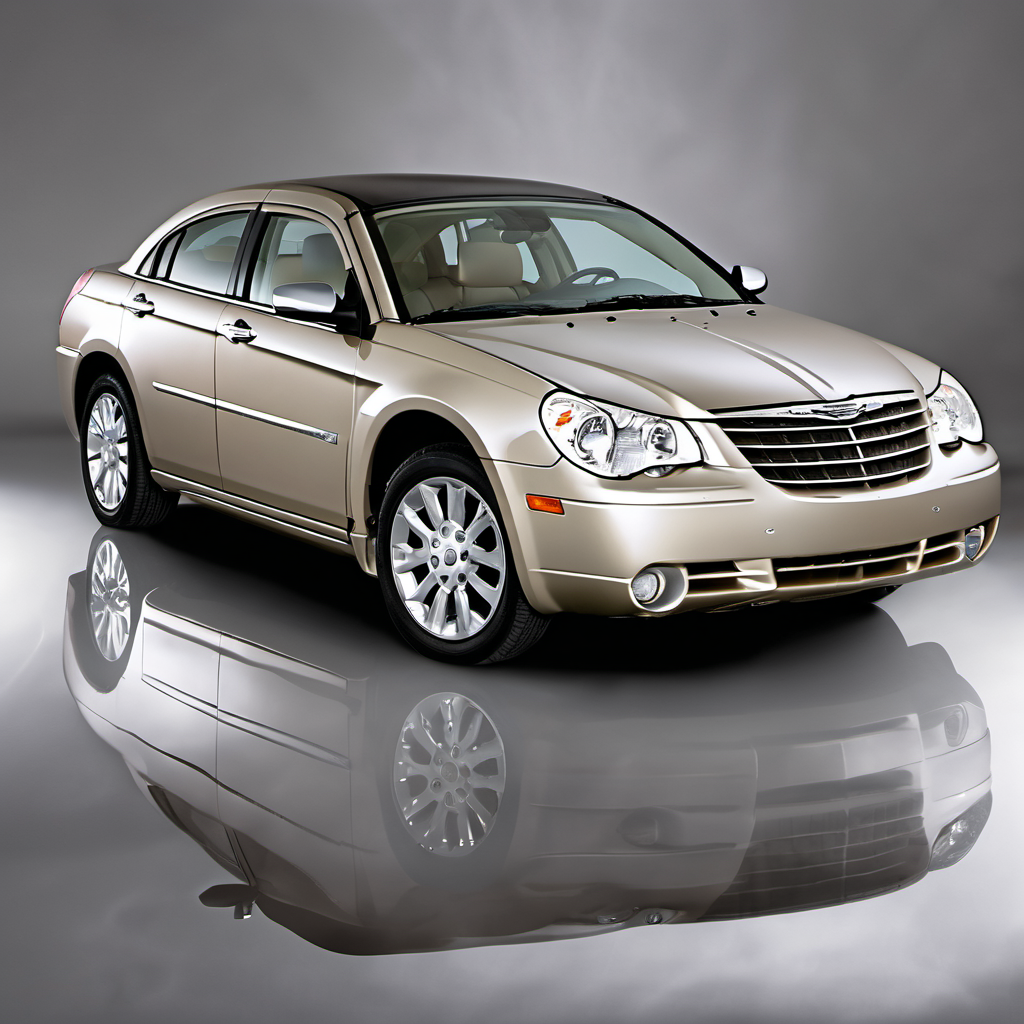
2007 Chrysler Sebring Sedan
Popular pick

2007 Chrysler

SebringSedan

2.4L DOHC 16-valve I4 · Sedan

The 2007 Chrysler Sebring Sedan was a complete ground-up redesign from the outgoing model, riding on Chrysler's JS platform. It was positioned as an affordable family sedan competing with the Camry and Accord, but it arrived with a reputation for cut-corner interior quality and a mediocre driving experience that never quite matched its ambitions. The base 2.4L four-cylinder is adequate for commuting but unremarkable, and the platform's long-term durability has proven to be a genuine concern for high-mileage buyers. On paper, the Sebring offers decent passenger room, a comfortable ride, and a reasonable feature list for its era. In practice, owners have dealt with persistent issues around the automatic transmission, cooling system, and electrical gremlins that crop up as these cars age past 80,000 miles. This generation (2007–2010) is widely considered one of Chrysler's weaker efforts from the mid-2000s. If you're looking at a used example today, value is the main draw — prices are low. But eyes wide open: budget for deferred maintenance and potential repairs, and inspect carefully before you buy.

Reliability
2/5
Verified data
Specs shown for Sebring — the most common configuration. Other trims may vary in engine, drivetrain, or fuel economy. Sign in to see your vehicle's exact specs.
Engine
[object Object]
Drivetrain
FWD/Front-Wheel Drive
Fuel
Gasoline
MPG
22 city / 30 highway
Seats
Doors
4
Body
Midsize Cars
MSRP
$20,595

Overview

AI-curated

The 2007 Chrysler Sebring Sedan was a complete ground-up redesign from the outgoing model, riding on Chrysler's JS platform. It was positioned as an affordable family sedan competing with the Camry and Accord, but it arrived with a reputation for cut-corner interior quality and a mediocre driving experience that never quite matched its ambitions. The base 2.4L four-cylinder is adequate for commuting but unremarkable, and the platform's long-term durability has proven to be a genuine concern for high-mileage buyers. On paper, the Sebring offers decent passenger room, a comfortable ride, and a reasonable feature list for its era. In practice, owners have dealt with persistent issues around the automatic transmission, cooling system, and electrical gremlins that crop up as these cars age past 80,000 miles. This generation (2007–2010) is widely considered one of Chrysler's weaker efforts from the mid-2000s. If you're looking at a used example today, value is the main draw — prices are low. But eyes wide open: budget for deferred maintenance and potential repairs, and inspect carefully before you buy.

Known for
  • Comfortable, soft ride quality
  • Spacious back seat for the class
  • Low used-market purchase price
  • Mediocre interior material quality
  • Higher-than-average repair frequency for a mainstream sedan
Best for
  • Budget-conscious commuters who want a full-size sedan feel
  • Short-trip city driving where ride comfort matters
  • Buyers who can do some of their own maintenance
Watch for
  • Automatic transmission shudder and early failure
  • Cooling system leaks leading to overheating
  • Electrical and module communication faults (U-codes)
  • Premature strut and suspension wear
  • Rust on rocker panels and wheel arches in salt-belt states

Common issues by mileage

6 known

Automatic Transmission Shudder / Premature Failure

high
Typically appears
60–120k mi
Estimated repair
$1,800 – $3,500

Cooling System Leaks (thermostat housing, water pump, hoses)

high
Typically appears
70–130k mi
Estimated repair
$250 – $900

Oxygen Sensor / Heater Circuit Failures

medium
Typically appears
80–120k mi
Estimated repair
$150 – $400

CAN Bus / Module Communication Loss (TIPM, PCM, TCM)

medium
Typically appears
90–160k mi
Estimated repair
$300 – $1,200

Front Strut and Suspension Wear (noise, handling degradation)

high
Typically appears
60–100k mi
Estimated repair
$400 – $900

Maintenance schedule

  1. 1
    Every 30,000 miles — do not wait for 'lifetime' Transmission fluid change

    Chrysler's 4-speed automatic in this generation is sensitive to fluid degradation. Fresh fluid is the single best way to delay the most expensive repair on this car.

  2. 2
    Every 50,000 miles or 5 years Coolant flush and system inspection

    The thermostat housing and water pump are known weak points. Inspect hoses and the housing for seepage at every oil change. Catching a small leak early beats a head gasket job.

  3. 3
    Every 5,000 miles — do not stretch to 7,500+ Engine oil change with correct 5W-20 or 5W-30 spec

    The 2.4L DOHC engine's VVT solenoids are oil-pressure dependent. Dirty, low, or wrong-viscosity oil is the leading cause of P0012/P0015 camshaft timing codes on this engine.

  4. 4
    Every 15,000–20,000 miles Air filter replacement

    Straightforward and inexpensive. A clogged filter forces the engine to work harder, stressing the already-stressed 4-speed automatic.

  5. 5
    Every 30,000 miles Spark plug replacement

    This engine uses standard copper plugs. Sticking to the shorter interval avoids misfires that can show up quickly in cold Wisconsin winters.

  6. 6
    Every 2–3 years Brake fluid flush

    Brake fluid absorbs moisture over time, lowering the boiling point and promoting internal corrosion — a real concern given Wisconsin's road salt environment.

  7. 7
    Every spring (after winter salt exposure) Inspect rocker panels, undercarriage, and wheel arches for rust

    The JS-platform Sebring is susceptible to body and frame rust in salt-belt states. Catching surface rust early and treating it can add years of safe life to the car.

  8. 8
    Every fall before winter Battery load test

    The 2007 Sebring's electrical system is sensitive to low battery voltage. A weak battery can trigger U-code module communication faults and erratic behavior in sub-zero temps.

Always defer to the manufacturer's service manual for warranty-mandated intervals.

Cost of ownership

Annual maintenance
$800 – $1,800
Fuel
At 25 MPG combined and ~12,000 miles/year, expect roughly $1,400–$1,700/year at current Wisconsin gas prices. The 2.4L is relatively efficient for a full-size sedan.
Insurance
Insurance is typically low — this is an older, low-value vehicle. Expect $700–$1,200/year for full coverage depending on driving history and location.

On paper the Sebring is cheap to own — low purchase price, decent fuel economy, low insurance. The risk is the unpredictable end of that range: a transmission replacement or cooling system failure can easily run $2,000–$3,500 in a single year. Budget conservatively. At this vehicle's age and popularity score, finding a well-maintained example is not guaranteed.
Seasonal care

Lake Geneva, WI
Winter
  • Test the battery every fall — cold temps below 0°F can kill a marginal battery fast, and the Sebring's electronics behave poorly on low voltage.
  • Switch to a full synthetic 5W-20 if not already using one; it flows better on cold starts and protects the VVT system until the engine warms up.
  • Flush the washer fluid reservoir and refill with a -20°F or lower rated fluid — the stock reservoir has no heater and Lake Geneva winters will freeze standard fluid solid.
  • Inspect the brake lines and underbody each fall for rust damage; road salt accelerates corrosion on this platform faster than average.
  • Check that the coolant freeze protection is rated to at least -34°F — a failing cooling system plus a Wisconsin winter is a guaranteed breakdown.
  • Keep the fuel tank above one-quarter to prevent fuel line moisture and keep the fuel pump cool during extended cold starts.
Summer
  • Check tire pressure monthly — every 10°F rise in ambient temperature adds about 1 PSI, and underinflated tires hurt the already-marginal fuel economy.
  • Inspect the A/C system for refrigerant charge and cabin filter condition before the heat sets in; the manual A/C on this trim is basic and doesn't recover well from neglect.
  • Watch the temperature gauge closely during stop-and-go traffic — the Sebring's cooling system is a known weak point and heat soak in traffic can push a marginal system over the edge.
  • Check all coolant hoses for softness or cracking after winter; temperature cycling accelerates hose degradation on this platform.

Comparable vehicles

If you're shopping for one

Red flags
  • Any evidence of overheating history (warped hood, discolored hoses, coolant stains on the engine) — head gasket damage is very expensive on this engine.
  • Transmission slipping, shuddering, or harsh shifts on the test drive — budget $2,000–$3,500 minimum if you proceed.
  • Active U0100–U0104 network codes — these can indicate a failing TIPM or PCM, which are costly and sometimes hard to source for this generation.
  • Heavy rust under the car, on the subframe, or on the brake lines — structural rust makes a Wisconsin winter car unsafe.
  • No maintenance records whatsoever on a car this age — the odds of deferred transmission or cooling service go up dramatically.
What to inspect
  • Transmission: test drive at highway speed and feel for shudder, slipping, or delayed engagement — these are expensive repairs and common on this car.
  • Cooling system: look for white residue around the thermostat housing, water pump, and hose ends. Ask for any records of cooling work.
  • Undercarriage and rocker panels: Wisconsin salt turns these into rust buckets. Look up under the car — don't just check the doors.
  • OBD-II scan before purchase: check for stored and pending codes, especially U-codes (module communication) and P0012/P0015 camshaft codes.
  • Engine oil condition: pull the dipstick. Milky or frothy oil means coolant intrusion — walk away.
  • Battery: ask when it was last replaced. If the answer is 'not sure,' plan to replace it before winter.
AI profile generated 4 days ago · claude-sonnet-4-6 · v2.