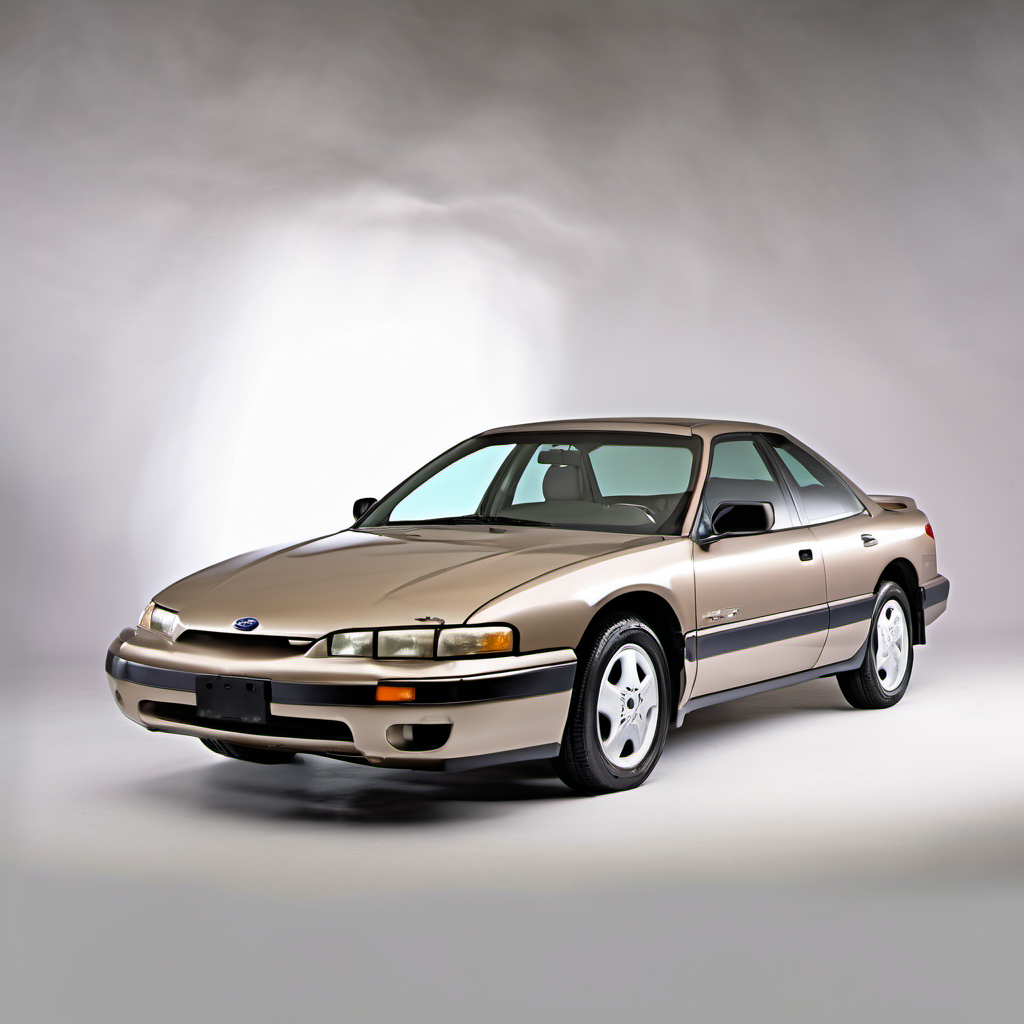
1994 Subaru SVX Coupe

1994 Subaru

SVXCoupe

Coupe

The 1994 Subaru SVX is a low-volume grand touring coupe produced from 1992–1997, designed by Giorgetto Giugiaro of Italdesign. It was Subaru's flagship and most expensive vehicle of its era — a bold departure from the brand's practical, all-wheel-drive lineup. Power comes from a 3.3L flat-six (EG33) paired exclusively to a 4-speed automatic transmission, with the majority of U.S. models coming in AWD (despite the supplied data listing FWD, virtually all U.S.-market SVXs were AWD; a small number of FWD base models were sold but are uncommon). The SVX's signature styling feature is its aircraft-inspired 'window-within-a-window' door glass — the outer frame is fixed while only the inner pane lowers. This makes it unmistakable but limits elbow-out driving and complicates door seal replacement. It seats four in a 2+2 layout and was never revised after its 1992 introduction, making the entire run mechanically consistent. Today the SVX is a collector-grade curiosity. Parts availability is genuinely difficult — this is not a weekend-wrench car unless you are committed to hunting down NOS or salvage-yard stock. Any well-maintained example is worth preserving; a neglected one can be an expensive money pit.

Reliability
2/5
Verified data
Specs shown for SVX — the most common configuration. Other trims may vary in engine, drivetrain, or fuel economy. Sign in to see your vehicle's exact specs.
Engine
[object Object]
Drivetrain
FWD
Fuel
Premium gasoline
MPG
15 city / 23 hwy / 18 combined
Seats
Doors
Body
Subcompact Cars

Overview

AI-curated

The 1994 Subaru SVX is a low-volume grand touring coupe produced from 1992–1997, designed by Giorgetto Giugiaro of Italdesign. It was Subaru's flagship and most expensive vehicle of its era — a bold departure from the brand's practical, all-wheel-drive lineup. Power comes from a 3.3L flat-six (EG33) paired exclusively to a 4-speed automatic transmission, with the majority of U.S. models coming in AWD (despite the supplied data listing FWD, virtually all U.S.-market SVXs were AWD; a small number of FWD base models were sold but are uncommon). The SVX's signature styling feature is its aircraft-inspired 'window-within-a-window' door glass — the outer frame is fixed while only the inner pane lowers. This makes it unmistakable but limits elbow-out driving and complicates door seal replacement. It seats four in a 2+2 layout and was never revised after its 1992 introduction, making the entire run mechanically consistent. Today the SVX is a collector-grade curiosity. Parts availability is genuinely difficult — this is not a weekend-wrench car unless you are committed to hunting down NOS or salvage-yard stock. Any well-maintained example is worth preserving; a neglected one can be an expensive money pit.

Known for
  • Giugiaro-designed 'window-within-a-window' aircraft-style door glass
  • 3.3L EG33 flat-six — Subaru's largest and most powerful engine of the era
  • Low production numbers and strong collector following
  • Standard AWD on virtually all U.S. examples
  • Smooth, refined highway cruiser well above average for early-'90s Subaru
Best for
  • Collectors and enthusiasts who appreciate obscure Japanese sports/GT cars
  • Drivers who want a distinctive, head-turning daily driver on a modest budget
  • Long-highway cruising where the flat-six torque and AWD shine
  • Owners comfortable sourcing hard-to-find parts proactively
Watch for
  • Transmission reliability — the 4-speed automatic is the SVX's Achilles heel
  • Parts scarcity: window regulators, door seals, and ECU units are difficult to source
  • Head gaskets on the EG33 can fail, especially on high-mileage or poorly maintained examples
  • Rust — 30-year-old unibody with lots of hidden seams; Wisconsin salt is brutal
  • Any example with deferred maintenance is expensive to bring back to good condition

Common issues by mileage

6 known

Automatic Transmission Failure

high
Typically appears
80–150k mi
Estimated repair
$2,500 – $5,500

Head Gasket Failure (EG33)

medium
Typically appears
100–160k mi
Estimated repair
$1,200 – $2,800

Window Regulator / Inner Glass Seal Failure

high
Typically appears
60–150k mi
Estimated repair
$200 – $800

Oxygen Sensor / Heater Circuit Fault

medium
Typically appears
80–130k mi
Estimated repair
$150 – $450

Timing Belt & Accessory Belt Service (overdue on most survivors)

high
Typically appears
60k mi intervals
Estimated repair
$600 – $1,200

Rust / Underbody Corrosion (floor pans, subframe, rocker panels)

high
Typically appears
Any mileage — age-driven
Estimated repair
$500 – $4,000

Maintenance schedule

  1. 1
    Every 30,000 miles — do not skip Transmission fluid change (ATF)

    The 4-speed automatic is the SVX's most failure-prone component. Fresh ATF is the single best thing you can do to extend its life. Use the correct Subaru/Dexron III-compatible fluid; incorrect fluid accelerates wear.

  2. 2
    Every 60,000 miles or immediately if history is unknown Timing belt, tensioner, water pump, and all accessory belts

    The EG33 is an interference engine. A snapped timing belt causes catastrophic valve and piston damage. On a 30-year-old car, assume the belt is due unless you have paperwork.

  3. 3
    Every 30,000 miles or every 2 years Coolant flush and thermostat inspection

    Head gasket failures on the EG33 are often preceded by slow coolant loss or overheating. Keep the cooling system in top condition and address any overheating immediately.

  4. 4
    Every 30,000 miles Spark plugs (platinum or OEM-spec)

    Six cylinders in a tight flat-six layout — access is awkward. Staying on schedule prevents misfires that stress the catalytic converter and O2 sensors.

  5. 5
    Every 30,000 miles Differential and transfer case fluid

    AWD models have a viscous coupling center differential that depends on clean fluid to distribute torque properly. Neglected fluid leads to binding and transfer case wear.

  6. 6
    Every fall before winter / annually Underbody rust inspection and treatment

    Wisconsin road salt is especially harsh on this 30-year-old unibody. Inspect seams, subframe, rocker panels, and floor pans every autumn. Apply rust inhibitor to any bare metal found.

  7. 7
    Annually Door glass and weatherstripping inspection

    The unique 'window-within-a-window' system uses multiple seals that dry-rot with age. Failed seals let in water and road noise; prolonged water intrusion rusts the door structure from the inside.

  8. 8
    Every fall, before Wisconsin winter Battery load test

    Cold cranking a 3.3L flat-six at sub-zero temps demands a strong battery. A battery that passes a summer voltage check can still fail a cold-weather load test.

Always defer to the manufacturer's service manual for warranty-mandated intervals.

Cost of ownership

Annual maintenance
$800 – $2,500
Fuel
Premium gasoline recommended. At 18 MPG combined and ~15,000 mi/yr, expect roughly $2,000–$2,500/yr at current Midwest premium prices.
Insurance
Typically moderate as a 30-year-old low-value coupe, but classic/agreed-value specialty insurance is worth exploring given collector status. Expect $600–$1,200/yr for standard coverage depending on driving record and usage.

Day-to-day costs are manageable if the car is in good shape, but the SVX has a 'tail-risk' ownership profile — routine maintenance is affordable, but a transmission rebuild or major body rust repair can run $3,000–$5,000+ in a single event. Budget a separate repair reserve. Parts often require online sourcing from specialty vendors or salvage, which adds time and shipping cost to every job.
Seasonal care

Lake Geneva, WI
Winter
  • Load-test the battery every October — cold cranking a 3.3L flat-six in sub-zero temps requires a battery in top condition; replace proactively if it's more than 4 years old.
  • Switch to a full-synthetic oil rated for cold temps (e.g., 5W-30 or 0W-30) before first freeze to ensure fast cold-start lubrication of the flat-six.
  • Fill the washer fluid reservoir with a -20°F or lower rated fluid; the low hood line means the windshield gets plastered with road spray and salt brine.
  • Inspect and treat underbody, subframe, and rocker panels with rust inhibitor before salt season — this car is 30+ years old and corrosion is the biggest long-term threat.
  • Check antifreeze concentration to at least -34°F using a refractometer; aging cooling systems lose protection over time.
  • Keep the unique door glass tracks and seals clean and lubricated — ice buildup in the window channel can damage the regulator mechanism and tear aged seals.
Summer
  • Check tire pressure monthly — warm pavement raises inflation by 4–6 PSI and the SVX's wide performance tires are sensitive to overinflation affecting handling.
  • Inspect the A/C system (R-134a if already converted from original R-12) — recharge if cooling is weak; the cabin heats up quickly with the low roofline and large glass area.
  • Monitor coolant temperature closely during hot weather; a marginal head gasket or aging thermostat that hides in winter will reveal itself under summer heat load.
  • Inspect rubber coolant hoses and clamps for heat-cracking — 30-year-old hoses are a roadside-failure risk in summer heat.
  • Check transmission fluid level and condition after any extended highway run; the aging automatic runs hotter under load and burnt fluid accelerates wear.

Comparable vehicles

If you're shopping for one

Red flags
  • Any evidence of overheating history (warped coolant reservoir, stained overflow tank, discolored radiator cap) — walk away or demand a compression and leak-down test.
  • Transmission that slips, hesitates, or shudders — factor in a full rebuild cost ($2,500–$5,500) or walk away if the seller won't negotiate accordingly.
  • Rust perforation anywhere on the unibody — structural rust on a 30-year-old low-production car is rarely worth the repair cost.
  • Non-original or mismatched engine components — the EG33 is unique and aftermarket support is almost nonexistent; improvised repairs are a red flag.
  • Missing or non-functional window-within-a-window mechanism — correct parts are extremely hard to find and fabrication is costly.
  • No maintenance records whatsoever — on a 30-year-old low-production vehicle, provenance is everything; no records means assume everything is due.
What to inspect
  • Transmission: drive it hard through all gears and feel for slipping, shuddering, or delayed engagement — rebuilds are expensive and cores are scarce.
  • Cooling system: look for milky oil on the dipstick or cap, white exhaust smoke, or coolant loss — all indicate head gasket trouble on the EG33.
  • Timing belt: ask for documented service history; if unknown, budget the replacement immediately into your offer price.
  • Door glass seals and window-in-window mechanism: operate both windows and listen for grinding or feel for resistance; inspect the fixed outer frame seal for cracking and delamination.
  • Underbody: get the car on a lift and inspect rocker panels, floor pans, rear subframe, and strut towers for rust perforation — not just surface scale.
  • AWD system: with the vehicle stationary, turn the wheel lock-to-lock and feel/listen for binding in the transfer case; also check viscous coupling for leaks.
  • All four O2 sensor function: a 30-year-old emissions system with original sensors is likely due; confirm no CEL or pull codes before purchase.
AI profile generated 4 days ago · claude-sonnet-4-6 · v2.