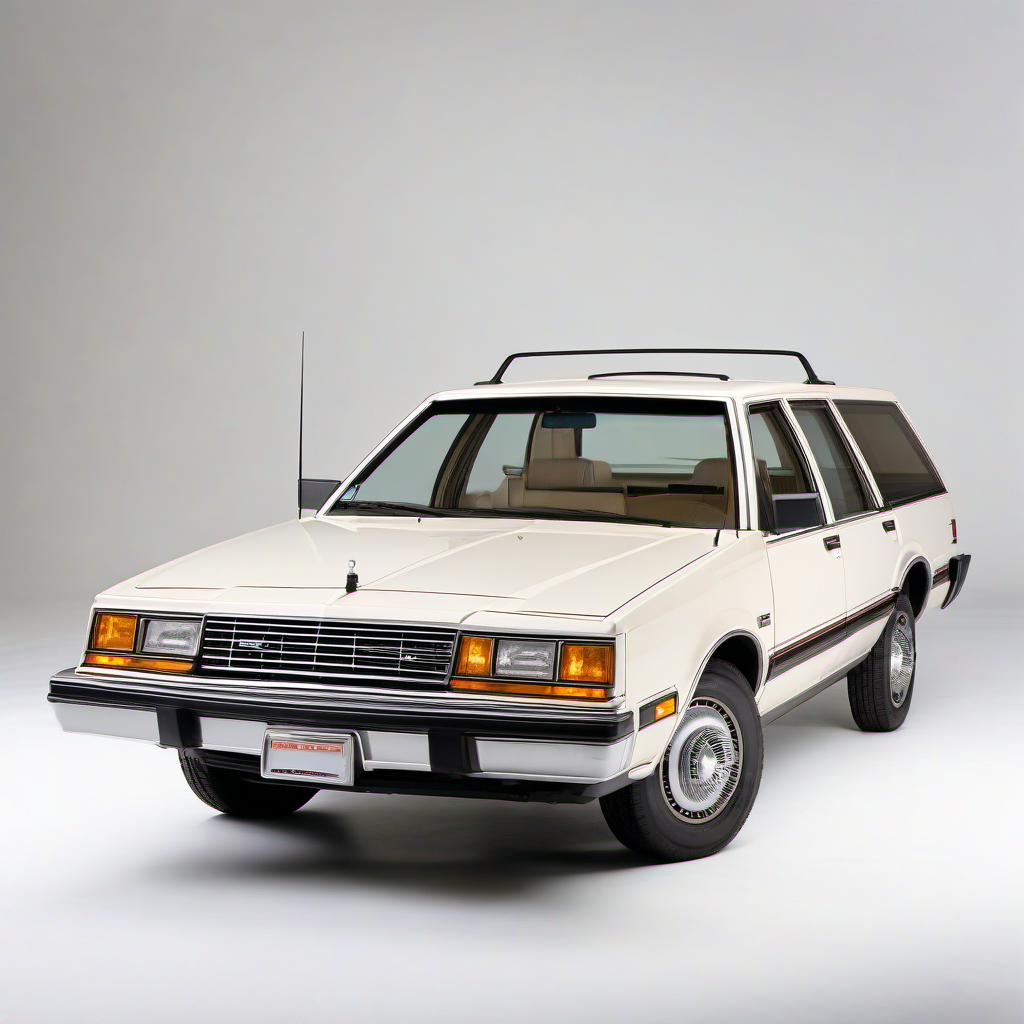
1984 Dodge Aries LE

1984 Dodge

AriesLE

2.5 L I4 · LE

The 1984 Dodge Aries LE is a compact front-wheel-drive sedan built on Chrysler's K-car platform — one of the most important vehicles in American automotive history. Launched in 1981, the K-car literally saved Chrysler from bankruptcy, offering affordable, fuel-efficient, practical transportation at a time when Americans were desperate for it. The LE trim added modest luxury touches: upgraded cloth or velour seating, wood-grain interior accents, and extra sound deadening. Under the hood sits Chrysler's 2.2L pushrod four-cylinder paired to either a 3-speed TorqueFlite automatic or a 4-speed manual. These engines and transmissions are legendarily simple — a mechanic who's worked on one has worked on all of them. Parts availability from salvage yards is excellent, and any competent independent shop can service this car without special tools. At 40 years old, any surviving Aries is a classic daily driver, a project car, or a piece of nostalgia. Expect to address deferred maintenance, rust, and aged rubber components on virtually every example you encounter. Survivors in good shape are genuinely usable, but this is no longer a car you buy and ignore — it requires attention.

Reliability
3/5
Verified data
Specs shown for Aries — the most common configuration. Other trims may vary in engine, drivetrain, or fuel economy. Sign in to see your vehicle's exact specs.
Engine
[object Object]
Drivetrain
Fuel
Gasoline
MPG
21 city / 26 hwy / 23 combined
Seats
Doors
Body
Midsize Cars

Overview

AI-curated

The 1984 Dodge Aries LE is a compact front-wheel-drive sedan built on Chrysler's K-car platform — one of the most important vehicles in American automotive history. Launched in 1981, the K-car literally saved Chrysler from bankruptcy, offering affordable, fuel-efficient, practical transportation at a time when Americans were desperate for it. The LE trim added modest luxury touches: upgraded cloth or velour seating, wood-grain interior accents, and extra sound deadening. Under the hood sits Chrysler's 2.2L pushrod four-cylinder paired to either a 3-speed TorqueFlite automatic or a 4-speed manual. These engines and transmissions are legendarily simple — a mechanic who's worked on one has worked on all of them. Parts availability from salvage yards is excellent, and any competent independent shop can service this car without special tools. At 40 years old, any surviving Aries is a classic daily driver, a project car, or a piece of nostalgia. Expect to address deferred maintenance, rust, and aged rubber components on virtually every example you encounter. Survivors in good shape are genuinely usable, but this is no longer a car you buy and ignore — it requires attention.

Known for
  • Chrysler K-car platform — cornerstone of Chrysler's 1980s revival
  • Simple, highly serviceable 2.2L four-cylinder engine
  • Thrifty fuel economy for its era
  • Spacious interior relative to its exterior footprint
  • Durable TorqueFlite 3-speed automatic transmission
Best for
  • Classic car enthusiasts and K-car collectors
  • Budget-conscious owners comfortable with vintage vehicle ownership
  • DIY mechanics who want an easy, parts-accessible project
  • Short-distance urban or suburban driving
Watch for
  • Extensive rust, especially rocker panels, floor pans, and rear wheel arches
  • Aged vacuum lines and rubber hoses that crack and leak
  • Carburetor issues — the 2.2L FFS (Feedback Fuel System) carburetor is finicky
  • Worn or collapsed engine mounts (very common at this age)
  • Electrical gremlins from aging wiring harnesses and connectors

Common issues by mileage

6 known

Carburetor problems (Feedback Fuel System / Holley 6520)

high
Typically appears
Any mileage — age-related
Estimated repair
$150 – $600

Rust — rocker panels, floor pans, rear wheel arches

high
Typically appears
Any mileage — age-related
Estimated repair
$400 – $3,000

Cracked or collapsed vacuum hoses and intake manifold gaskets

high
Typically appears
Any mileage — age-related
Estimated repair
$100 – $400

Worn or broken engine and transmission mounts

high
Typically appears
Any mileage — age-related
Estimated repair
$150 – $350

Aging wiring harness — brittle insulation, bad grounds, failing connectors

medium
Typically appears
Any mileage — age-related
Estimated repair
$100 – $800

Worn front-end suspension components (tie rods, ball joints, strut bushings)

medium
Typically appears
Any mileage — age-related
Estimated repair
$200 – $700

Maintenance schedule

  1. 1
    Immediately on acquisition; every 3–5 years thereafter Inspect and replace all vacuum hoses

    40-year-old rubber is cracked and brittle. Vacuum leaks cause rough idle, poor fuel economy, and hard starting — all symptoms easily mistaken for carburetor failure.

  2. 2
    Every 2 years or whenever idle/fuel delivery issues appear Carburetor cleaning and adjustment

    The Holley 6520 feedback carburetor gums up from ethanol-blended fuel and sitting. A clean, properly adjusted carb is essential for reliable cold starts and smooth running.

  3. 3
    Every 2 years Coolant flush and thermostat replacement

    Old coolant loses its corrosion inhibitors and eats away at the iron block and aluminum head. The 2.2L is sensitive to overheating — a stuck thermostat can cause head gasket failure.

  4. 4
    Every 60,000 miles or immediately if history is unknown Timing belt inspection and replacement

    The 2.2L uses a timing belt. Interference-style concerns aside, a snapped belt leaves you stranded. On a vehicle this age, replace it if you don't have documented history.

  5. 5
    Immediately on acquisition; annually thereafter Full brake inspection — lines, hoses, drums/discs, wheel cylinders

    Rubber brake hoses and steel lines are 40 years old. Hoses can look fine externally while collapsing internally; steel lines rust through. This is a safety-first item.

  6. 6
    Every 3,000 miles or 6 months Engine oil and filter change

    Older engines with looser tolerances benefit from more frequent oil changes, especially during Wisconsin winters when condensation accumulates in the crankcase.

  7. 7
    Every spring after winter salt exposure Inspect undercarriage for rust — floor pans, frame rails, rocker panels

    Wisconsin road salt is brutal. Even cosmetically clean cars can have structurally compromised floors or sills. Catch it early — surface rust is manageable, perforation is not.

  8. 8
    Every fall before winter season Battery and charging system test

    Cold cranking a 40-year-old carbureted engine demands a strong battery. The original alternator and voltage regulator are age-suspect; test the full system each fall.

Always defer to the manufacturer's service manual for warranty-mandated intervals.

Cost of ownership

Annual maintenance
$400 – $1,500
Fuel
At ~23 MPG combined and modest driving, expect $800–$1,400/year at current Wisconsin fuel prices — reasonable for a vintage vehicle.
Insurance
Classic or agreed-value coverage is often available and affordable for a 40-year-old vehicle with limited annual mileage. Standard liability coverage runs low given the car's current market value.

A well-maintained Aries is inexpensive to operate — parts are cheap, labor is straightforward, and fuel economy is decent. The risk is deferred maintenance catching up all at once. Budget for a thorough mechanical assessment up front ($300–$600), and plan for one or two larger repairs in the first year of ownership. Once caught up, annual costs are modest for a classic car.
Seasonal care

Lake Geneva, WI
Winter
  • Test battery cold-cranking amps every fall — sub-zero starts stress any battery, and an aging charging system may not keep a marginal battery topped off.
  • Switch to a lighter-weight conventional oil (5W-30) if the car sits outside; the 2.2L carbureted engine needs easy cold cranking.
  • Fill the washer reservoir with -20°F or colder rated fluid — Wisconsin winters regularly push past what standard fluid handles.
  • Inspect rubber brake hoses for cracking before winter; cold makes brittle hoses fail suddenly.
  • Apply a rust inhibitor or underbody coating to exposed metal before first salt exposure of the season.
  • Keep the fuel tank at least half full to reduce condensation in the tank and prevent fuel-line freeze in the carb circuit.
Summer
  • Check coolant concentration and condition — the 2.2L runs warm and a marginal cooling system will boil over in stop-and-go traffic.
  • Inspect the carburetor for vapor lock symptoms (hot restarts, stalling after short stops) — common on carbureted cars in summer heat.
  • Check tire pressure monthly; heat increases pressure and 40-year-old vehicles often have age-cracked tires regardless of tread depth — inspect sidewalls carefully.
  • Test the A/C system if equipped — R-12 refrigerant is no longer available new; confirm the system has been converted to R-134a or budget for the conversion.

Comparable vehicles

1984 Plymouth Reliant
1984 Plymouth
Reliant

Essentially the same car — the Reliant is the Plymouth badge-twin of the Aries on the same K-car platform. Parts are fully interchangeable.

1984 Chevrolet
Citation

GM's competing front-wheel-drive compact from the same era. Similar mission and price point, though the Citation has a notably worse reliability reputation than the Aries.

No catalog match
1984 Ford
Tempo

Ford's answer to the K-car — a compact FWD sedan in the same price and size class, introduced in 1984. Comparable ownership experience as a vintage vehicle today.

No catalog match
1984 Volkswagen
Jetta

European compact in the same segment offering FWD, similar interior space, and a comparable fuel-efficient inline-four — a more driver-focused alternative from the same period.

No catalog match

If you're shopping for one

Red flags
  • Any soft or perforated floor pans — structural rust this severe is rarely worth repairing economically.
  • Engine that won't idle smoothly after warm-up — may indicate deeper engine wear or a carb that needs full rebuilding.
  • Visible oil leaks from the valve cover, timing belt cover, or rear main seal combined with low oil — sign of extended neglect.
  • A/C still on R-12 refrigerant with no conversion — system likely hasn't been touched in decades; budget $300–$500 for R-134a conversion.
  • Any signs of a flood or long-term outdoor storage: mold smell, water stains on headliner, corroded electrical connectors throughout.
What to inspect
  • Floor pans — press firmly with your foot in the footwells and cargo area; soft spots mean rust-through.
  • Rocker panels and rear wheel arches — probe with a screwdriver; bubbling paint almost always means rot underneath.
  • Carburetor operation — cold start, warm idle, and throttle response should all be smooth; hesitation or rich/lean surging signals carb work needed.
  • All rubber: coolant hoses, vacuum lines, brake hoses, CV axle boots — plan to replace anything that looks original.
  • Timing belt condition and documented replacement history — if unknown, budget for immediate replacement.
  • Brake lines along the frame rails for rust perforation — use a flashlight and look for white salt deposits or pinhole rust on steel lines.
AI profile generated 4 days ago · claude-sonnet-4-6 · v2.