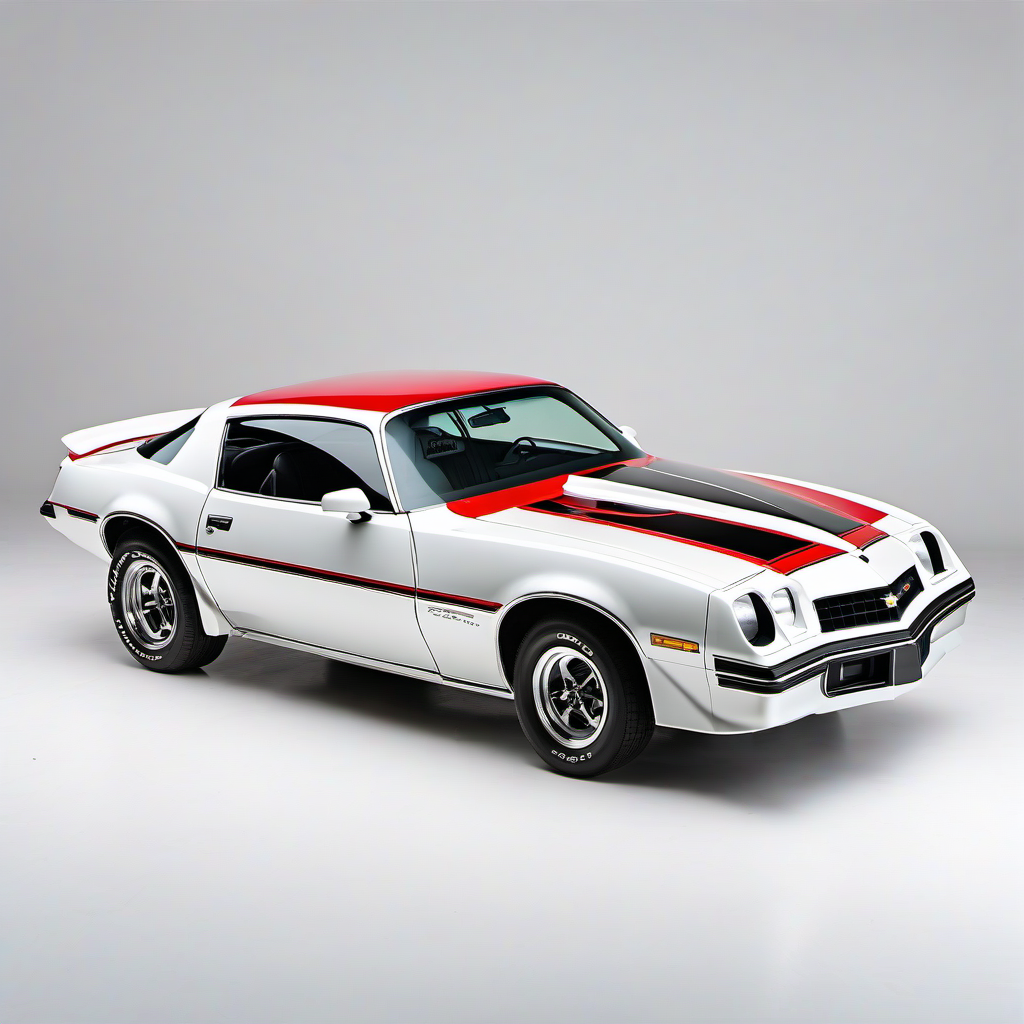
1980 Chevrolet Camaro Base
Popular pick

1980 Chevrolet

CamaroBase

350 CI V8 · Base

The 1980 Chevrolet Camaro is a second-generation muscle car (technically third-gen by body, second by heritage) that arrived during one of the toughest eras for American performance. Emissions regulations and the fuel crisis had already neutered the big-block options, and by 1980 even the 350 V8 was producing modest numbers compared to its late-'60s ancestors. Still, the F-body Camaro remained an iconic, rear-wheel-drive pony car with a loyal following and a platform that was genuinely fun to drive when kept in good shape. The base 350 CI (5.7L) small-block V8 was a Rochester carburetor-fed unit rated at around 190 hp — not especially powerful by modern standards, but a proven and extremely rebuildable engine. The car rode on a front subframe with independent front suspension and a live rear axle, a simple layout that makes home and independent-shop work straightforward. Parts availability is excellent thanks to a massive aftermarket. Owning a 44-year-old Camaro is a different proposition than owning a modern daily driver. Expect to address deferred maintenance, aging rubber components, electrical gremlins from decades-old wiring, and rust — especially on a Wisconsin car. But for the right enthusiast, these cars reward careful ownership with character and a community that is hard to match.

Reliability
3/5
Verified data
Engine
5.7L V8 (350 CI)
Drivetrain
RWD
Fuel
Gasoline
MPG
13 city / 20 hwy / 16 combined
Seats
4
Doors
2
Body
Coupe
MSRP
$6,600

Overview

AI-curated

The 1980 Chevrolet Camaro is a second-generation muscle car (technically third-gen by body, second by heritage) that arrived during one of the toughest eras for American performance. Emissions regulations and the fuel crisis had already neutered the big-block options, and by 1980 even the 350 V8 was producing modest numbers compared to its late-'60s ancestors. Still, the F-body Camaro remained an iconic, rear-wheel-drive pony car with a loyal following and a platform that was genuinely fun to drive when kept in good shape. The base 350 CI (5.7L) small-block V8 was a Rochester carburetor-fed unit rated at around 190 hp — not especially powerful by modern standards, but a proven and extremely rebuildable engine. The car rode on a front subframe with independent front suspension and a live rear axle, a simple layout that makes home and independent-shop work straightforward. Parts availability is excellent thanks to a massive aftermarket. Owning a 44-year-old Camaro is a different proposition than owning a modern daily driver. Expect to address deferred maintenance, aging rubber components, electrical gremlins from decades-old wiring, and rust — especially on a Wisconsin car. But for the right enthusiast, these cars reward careful ownership with character and a community that is hard to match.

Known for
  • Iconic F-body styling with a long hood and fastback roofline
  • Simple, rebuildable 350 small-block V8 with massive parts support
  • Rear-wheel drive with a live axle — straightforward to work on
  • Strong enthusiast community and aftermarket ecosystem
  • Emissions-era detuning that left plenty of room for restoration or mild upgrades
Best for
  • Enthusiasts who want a classic American pony car project or weekend driver
  • Owners comfortable with ongoing mechanical upkeep on a vintage vehicle
  • Collectors interested in late second-gen / early third-gen Camaro history
  • Drivers who do most wrenching themselves or have a trusted independent shop
Watch for
  • Severe rust in floor pans, frame rails, and rear wheel wells — critical on Midwest cars
  • Decades-old wiring insulation that cracks and causes shorts or fires
  • Carburetor flooding, vapor lock, and hard starting in summer heat
  • Leaking rear main seals and valve cover gaskets on high-mileage 350s
  • Previous owner modifications that may have introduced safety or reliability issues

Common issues by mileage

6 known

Floor pan and frame rail rust

high
Typically appears
All mileages on Midwest cars
Estimated repair
$800 – $4,000

Carburetor issues — flooding, hard starting, vapor lock

high
Typically appears
All mileages
Estimated repair
$150 – $600

Rear main seal and valve cover gasket oil leaks

high
Typically appears
80k+ mi
Estimated repair
$200 – $700

Aging wiring harness — cracked insulation, shorts, intermittent electrical faults

high
Typically appears
All mileages
Estimated repair
$300 – $2,500

Worn front suspension — ball joints, tie rod ends, idler arm

medium
Typically appears
60k+ mi
Estimated repair
$250 – $900

Leaking brake system — wheel cylinders, master cylinder, rotting rubber lines

medium
Typically appears
All mileages on older vehicles
Estimated repair
$200 – $1,200

Maintenance schedule

  1. 1
    Every 12–15k miles or annually Tune-up — plugs, points or HEI cap/rotor, plug wires, air filter

    The HEI distributor (standard on 1980) is robust but the cap, rotor, and wires age and crack. Fresh plugs and wires are the single biggest bang-for-buck on a carbureted V8.

  2. 2
    Every 2–3 years or when drivability issues appear Carburetor inspection and rebuild as needed

    The Rochester Quadrajet carb is excellent when clean but gums up with ethanol-blended modern fuel, especially during storage. Rebuild kits are cheap; ignoring it is not.

  3. 3
    Every 3,000–4,000 miles with conventional oil Engine oil and filter change

    Old engines with worn clearances benefit from more frequent changes. Use a zinc-phosphorus (ZDDP) additive or high-zinc conventional oil to protect the flat-tappet camshaft.

  4. 4
    Every 2 years Cooling system flush and hose inspection

    Forty-year-old cooling systems are prone to internal scale buildup and hose failure. A rupture in Wisconsin winter or summer heat is a breakdown waiting to happen.

  5. 5
    Every 2 years minimum Brake fluid flush and rubber line inspection

    Original or aged rubber brake lines become dangerously brittle. Inspect all flex lines and replace any that show cracking or swelling. Brake failure on a vintage car is a real hazard.

  6. 6
    Annually Fuel system inspection — tank, lines, pump, filter

    Ethanol in today's pump gas attacks old rubber fuel lines and can corrode the steel tank. Replace rubber lines, run a quality fuel filter, and consider a tank cleaning if the history is unknown.

  7. 7
    Annually — every spring after Wisconsin winter Undercarriage rust inspection and treatment

    Road salt is the enemy. Inspect frame rails, floor pans, and rear wheel arches every spring. Treat bare metal immediately; rust that is addressed early costs hundreds, not thousands.

  8. 8
    Every fall before winter storage or Wisconsin cold season Battery and charging system check

    The alternator and voltage regulator on these cars are simple but age. A weak battery in sub-zero temps will leave you stranded. Test both before cold weather arrives.

Always defer to the manufacturer's service manual for warranty-mandated intervals.

Cost of ownership

Annual maintenance
$600 – $2,500
Fuel
Expect 14–16 MPG in real-world mixed driving. At current Wisconsin pump prices, budget $1,800–$2,800/year for a moderate driver (~8,000 miles). Premium is not required but 87 octane with low ethanol content is preferred.
Insurance
Classic/collector car insurance (agreed value policy) is typically $300–$700/year for a pleasure-use Camaro with limited annual mileage. Standard auto insurance will cost significantly more and may not cover agreed value in a total loss.

Annual costs are manageable if the car is already in good mechanical shape, but budget for surprises on a 44-year-old vehicle. A single major job — floor pan repair, wiring harness replacement, or engine rebuild — can easily run $2,000–$5,000. The upside is that parts are cheap, labor is simpler than modern cars, and a well-maintained example holds or appreciates in value.

Seasonal care

Lake Geneva, WI
Winter
  • Do not daily-drive this car on salted Wisconsin roads — salt will accelerate rust on an already vulnerable 44-year-old body. Store it if at all possible from November through April.
  • If storage is not an option, rinse the undercarriage thoroughly after every salt exposure and dry it before re-parking.
  • Use a trickle/battery maintainer charger during storage — the electrical system on these cars draws small parasitic loads and a dead battery in a stored car is common.
  • Add a quality fuel stabilizer if the car will sit more than 30 days; ethanol-blended fuel degrades rapidly and varnishes the carburetor.
  • Check coolant freeze protection to at least -34°F before first cold snap — old coolant loses its freeze protection over time.
  • Change to a slightly lighter viscosity conventional oil (e.g., 10W-30) if the car must be started regularly in sub-zero temps to reduce cold-start wear.
Summer
  • Vapor lock is a real problem on carbureted V8s in summer heat — if the car stalls when hot and won't restart for 10–20 minutes, inspect fuel line routing and consider a heat shield on the fuel line near the exhaust.
  • Check tire pressure monthly — for every 10°F rise in ambient temperature, pressure increases roughly 1 PSI. Overinflation in summer heat reduces grip on a car that already has vintage tires.
  • Inspect the radiator cap and overflow bottle — the cooling system must hold pressure to prevent boil-over during hot weather or traffic idling.
  • The A/C system on a 1980 Camaro uses R-12 refrigerant, which is no longer manufactured. If the A/C is not working, a shop can retrofit to R-134a. Do not attempt to top off an R-12 system without knowing what refrigerant is currently in it.
  • Check the battery condition — heat kills batteries as much as cold does, and a weak battery combined with high electrical load from a working A/C system will strand you.

Comparable vehicles

1980 Pontiac
Firebird

Shares the same F-body platform, nearly identical mechanicals, similar pricing and parts availability. The Trans Am variant is the closest spiritual twin to the Camaro in this era.

No catalog match
1980 Ford
Mustang

The Fox-body Mustang (1979–1980) is the direct segment rival — also a rear-wheel-drive American pony car with a V8 option, a large aftermarket, and similar collector interest.

No catalog match
1980 Dodge
Challenger

Mopar's pony car entry from this era competes for the same collector dollar, though parts availability and community are smaller than the F-body or Fox Mustang camps.

No catalog match
1979 Chevrolet
Monte Carlo

If the appeal is the 350 small-block in a classic American coupe, the G-body Monte Carlo offers similar mechanicals, a more relaxed driving character, and often lower purchase prices.

No catalog match

If you're shopping for one

Red flags
  • Any floor pan or frame rust that flexes or perforates under hand pressure — walk away or price in a full restoration
  • Engine that runs rough cold, blows smoke, or shows milky oil — indicates internal engine damage
  • Brake pedal that goes to the floor or feels spongy — do not drive until fully inspected and repaired
  • Obvious electrical fires or heavy tape-wrapped wiring throughout the harness — complete rewire needed
  • Mismatched or missing VIN tags — potential title or theft issues
  • Evidence of flood damage — check under carpet and in the trunk for water lines or mud residue
What to inspect
  • Probe every floor pan seam, rocker panel, and rear wheel arch with a screwdriver — rust-through here is a major structural and cost concern
  • Inspect the frame rails front to back for rust perforation, especially behind the front subframe mounts
  • Pull all four wheels and inspect the brake lines, wheel cylinders, and hardware — original rubber lines are 44 years old
  • Start the engine cold and watch for blue smoke (worn rings/valve seals) or excessive ticking (worn cam or lifters — critical on a flat-tappet engine)
  • Check for oil leaks at the rear main, valve covers, and intake manifold gasket — all common on high-mileage 350s
  • Inspect the wiring harness under the dash and in the engine bay for cracked, melted, or mouse-chewed insulation
  • Look for signs of amateur modification — mismatched wiring splices, non-original engine or transmission, aftermarket fuel system work
  • Verify the VIN plate on the dash matches the partial VIN stamped on the engine pad and body tags
AI profile generated 20 days ago · claude-sonnet-4-6 · v2.